What is the difference between a water filter and a purifier?
Short answer
Purifier is a standard, not a grade. The EPA's published guide standard asks a purifier to reduce bacteria, protozoan cysts and viruses; a filter typically claims only the first two, because viruses are smaller than a 0.1 or 0.2 micron pore. Where you're drinking decides which word matters.
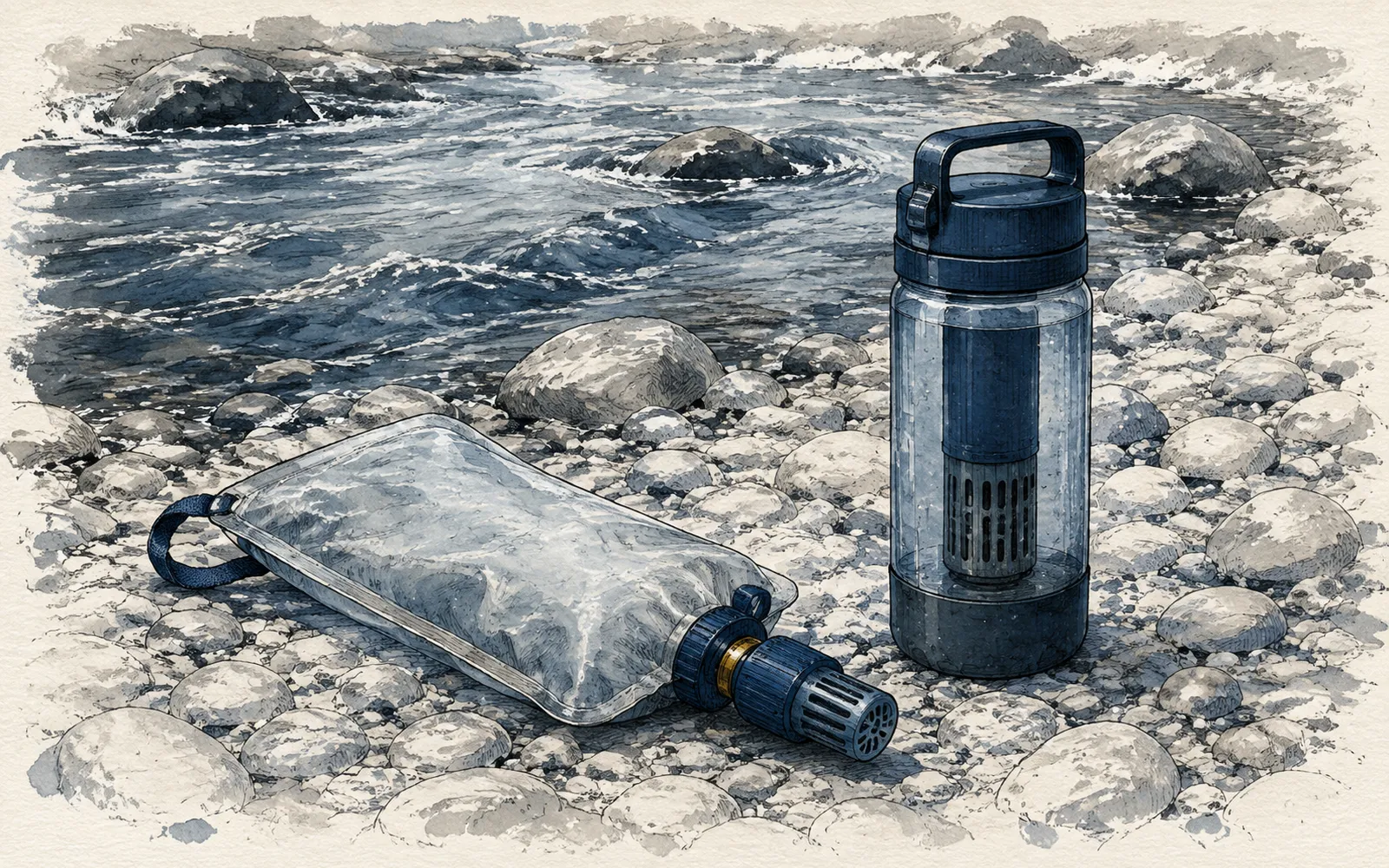
Two bottles on a shelf, one marked filter and one marked purifier, the second costing more. It reads like a quality ladder. It isn’t — it’s a list of what got tested.
Purifier points at a specific document with numbers in it. Filter points at everything else. Which you need is a question of geography, not budget.
What actually separates a water filter from a water purifier?
A purifier clears the reduction bar for all three classes of organism — bacteria, protozoan cysts and viruses — where a filter typically claims only the first two.
The document behind the word is the EPA’s 1987 Guide Standard and Protocol for Testing Microbiological Water Purifiers. It defines a microbiological water purifier as a device that must “remove kill or inactivate all types of disease-causing microorganisms from the water, including bacteria, viruses and protozoan cysts,” then sets three figures against three named challenge organisms: 6 log (99.9999%) against Klebsiella terrigena, 4 log (99.99%) against Poliovirus 1 and Rotavirus, and 3 log (99.9%) against Giardia.
A log reduction is a count of decimal places: each log is a tenfold cut in the organisms present, so 3 log takes out 999 of every thousand and 6 log takes out 999,999 of every million.
The USDA Forest Service put the split into two sentences in its 2007 tech tips on Personal Water Treatment Devices. A microfilter “meets The Standard for both protozoa-cyst reduction and bacteria reduction. It does not remove viruses.” A purifier “meets The Standard for cyst, bacteria, and virus reduction.” The same page adds that “a one-micron-absolute filter only meets The Standard for protozoa-cyst reduction” — pore size moves what you can claim even inside the filter category.
NSF carries that work forward as NSF/ANSI P231. P231 is not NSF/ANSI 42, which covers “aesthetic impurities such as chlorine and taste/odor,” nor NSF/ANSI 53, which covers a contaminant “with a health effect.” A claim against 42 and 53 is not a claim against P231.
Why can’t a 0.1 micron filter stop a virus?
Because the virus is smaller than the hole, and money doesn’t change that.
The joint NSF/EPA verification program gives the numbers plainly. Its virus surrogate MS-2 is “a suitable surrogate for pathogenic viruses because of its small size, at 24 nanometers in diameter” — 0.024 micron. The same report gives Cryptosporidium parvum a diameter of 4–6 µm and Bacillus atrophaeus endospores an average of 0.8 µm across.
Against a 0.1 micron pore, then: a cyst is roughly fifty times too wide to fit, a bacterium about eight times, and a virus is a quarter of the opening. The EPA’s Membrane Filtration Guidance Manual puts microfiltration at roughly 0.1–0.2 µm and ultrafiltration at 0.01–0.05 µm. Every squeeze filter in a backpacking aisle sits in the first band.
LifeStraw sells both bands in one product line, which makes the point better than any argument. Its Peak Series straw is a 0.2 micron filter claiming bacteria and parasites; its Peak Series gravity unit is a 0.02 micron ultrafilter claiming viruses too. Ten times smaller pore, one extra pathogen class, same company.
Which makers claim the standard, and in what words?
Three of the pages checked here name a standard; the rest use phrases that sound like one.
| Product | Pore size, as published | Virus claim | Standards wording, verbatim | Rated life |
|---|---|---|---|---|
| Sawyer Micro Squeeze | 0.1 micron absolute hollow fiber | none | “exceeding EPA recommendations for removal rates” | 100,000 gallons |
| Katadyn Pocket | 0.2 microns, ceramic depth filter | none | no standard named | “up to 50’000 litres, depending on the water quality” |
| Katadyn BeFree 0.6L | 0.1 micron (0.0001 mm) | none | test report cited to “Bachema AG, Switzerland, 05.04.2016” | 1,000 l |
| Platypus QuickDraw | 0.2 micron hollow fiber | “No” | “individually tested to ensure it meets all EPA & NSF guidelines” | 1,000 L |
| LifeStraw Peak Series straw | 0.2 micron | none | “Meets US EPA & NSF P231 … for the removal of bacteria and parasites” | 4,000 L |
| LifeStraw Peak Series gravity purifier | 0.02 micron | 99.99% | “Meets US EPA & NSF P231 … for the removal of viruses, bacteria, and parasites” | 18,000 L |
| Grayl GeoPress cartridge | not published | 99.99% | “meets … the EPA’s Guide Standard and Protocol for testing microbiological water purifiers” | 350 cycles, 65 gal / 250L |
| CamelBak LifeStraw bottle filter | not published | none | “tested by independent labs and meet NSF/ANSI International standards” | up to 100 liters |
| SteriPEN Ultra | not applicable — UV | “Eliminates bacteria, protozoa and viruses” | no standard named | 8,000 activations |
None of those nine pages uses the word certified against P231 — they say “meets,” “tested to,” or nothing.
Read that column downward, because it’s the checkable part. LifeStraw names the standard and scopes the claim by pathogen class, changing one clause between two products. Grayl names the EPA document in full, then separately says its cartridge was “independently tested by a certified laboratory to meet or exceed NSF/ANSI protocol 42 and 53” — standards that, per NSF, cover taste and chemical contaminants, not microbiological purification. Platypus, CamelBak and Sawyer invoke EPA and NSF without naming a document. Katadyn makes no standards claim at all, citing a named laboratory and a test date on the BeFree fact sheet instead — arguably the most falsifiable line of the lot.
What does each treatment technology actually address?
Membranes and ceramic strain by size, carbon adsorbs, and UV and chemicals inactivate without removing anything.
Hollow fiber is the default — bundles of straw-like membranes, used by Sawyer, LifeStraw, Platypus and Katadyn’s BeFree, all in the microfiltration band. Ceramic excludes by size too, but as a thick depth medium rather than a wall: Katadyn’s Pocket uses a silver-impregnated ceramic rated at one liter per minute, with a 20-year warranty, and can be physically scrubbed in the field, which a sealed hollow-fiber cartridge can’t be. Powdered carbon does something else: it adsorbs dissolved molecules onto a large internal surface area rather than blocking them by size, which is why Grayl’s cartridge is the only unit here making chemical claims.
UV and chemicals inactivate rather than filter, so nothing leaves the water. SteriPEN’s Ultra treats 0.5 L in 48 seconds and 1 L in 90 seconds, rated for 8,000 activations, and states its own limit outright: “Use only on clear water, as cloudy, sediment-laden water hinders effectiveness.” Katadyn’s Micropur MP1 tablets do the same job on a longer clock — chlorine dioxide at 4 ppm in-use concentration, one tablet per liter, a stated 4-hour wait and a five-year shelf life. No cartridge to clog is why tablets keep turning up in a 72-hour kit alongside a filter rather than instead of it.
What does a lifespan figure in gallons actually promise?
Whatever water the maker chose to run through it — and most don’t say what that was.
The spread is absurd on its face. CamelBak rates its LifeStraw bottle filter at “up to 100 liters” — “for heavy use, that could be as few as 2 weeks.” Sawyer rates the Micro Squeeze “up to 100,000 gallons”, roughly 378,000 liters. A factor of about 3,800 between two devices on the same shelf, and neither page states the water the figure came from.
Katadyn at least attaches a variable, twice: “up to 50’000 litres, depending on the water quality” for the Pocket, “up to 1,000 l depending on water quality” on the BeFree fact sheet. Not a test condition, but an honest signal.
Grayl gives the most usable version by not leaning on a total. Its cartridge is rated for 350 cycles (65 gal. / 250L), then the page tells you to watch behavior instead: replace it when “press time reaches ~25 seconds,” or after three years. An endpoint you can observe beats a total you’d have to count.
Flow degradation is what these numbers are really about. Sawyer’s remedy is backwashing, and it publishes what that recovers: “A good backwash after every use can restore up to 98% of the original flow rate of your filter.” Katadyn’s ceramic gets scrubbed. Published flow rates — 3 L/min squeezed for the QuickDraw, one liter per minute pumped for the Pocket — are the clean-filter top of the range, not an average. If you’d rather skip cartridge maintenance on a short trip, the fuel arithmetic in our guide to stove boil times is the other half of that decision.
What does neither a filter nor a purifier remove?
Dissolved chemicals, heavy metals and salt, unless the maker specifically claims it — and most make no such claim.
Size exclusion cannot catch a dissolved ion, which is far smaller than the 24-nanometer virus that already passes a microfilter. A finer membrane doesn’t help, because it isn’t a filtration problem.
Grayl claims otherwise on the strength of carbon rather than pore size: its cartridge page says the “ultra-powdered activated carbon effectively adsorbs chemicals (including PFAS & VOCs), pesticides, heavy metals” — and publishes no percentage reduction for any of them, which is worth noting next to the three pathogen figures it does publish.
On salt, two makers say it flatly: CamelBak’s filters “do not work in saltwater or brackish water”, and Sawyer’s are “not for use with salt water”. Nothing in this roster claims desalination.
The short version
Filter and purifier aren’t marketing tiers; they’re a line drawn by the EPA’s published guide standard, which asks a purifier for bacteria, cysts and viruses at 6, 3 and 4 log while a filter usually stops at the first two. That gap is physics, not build quality: a virus runs about a quarter the width of a 0.1 micron pore. So read the standards line rather than the price — LifeStraw and Grayl name the document, Platypus, CamelBak and Sawyer gesture at EPA and NSF without naming one, Katadyn names a laboratory. And treat every capacity figure as unverified until the maker says what water produced it.
Quick answers
- Does a 0.1 micron water filter remove viruses?
- Makers of 0.1 and 0.2 micron hollow-fiber filters generally don't claim it. Platypus lists viruses as "No" on the QuickDraw's own spec table. Sawyer's Micro Squeeze page claims bacteria and protozoa and says nothing about viruses. The reason is size: the EPA/NSF verification program describes the MS-2 virus surrogate as 24 nanometers in diameter, roughly a quarter of a 0.1 micron pore.
- What does a 6-log reduction mean?
- A log reduction counts decimal places. Each log is a tenfold cut in the number of organisms present, so 1 log removes 90 percent, 3 log removes 99.9 percent, and 6 log removes 99.9999 percent — 999,999 of every million. The EPA's published guide standard for microbiological water purifiers uses 6 log for bacteria, 4 log for viruses and 3 log for protozoan cysts.
- Do backcountry water filters remove heavy metals, chemicals or salt?
- Not unless the maker specifically claims it, and most don't. Grayl is the exception among the makers checked here, stating that its activated carbon adsorbs chemicals including PFAS and VOCs, pesticides and heavy metals — without publishing a percentage reduction for any of them. On salt, both CamelBak and Sawyer state plainly that their filters are not for use with salt water or brackish water.
- What is the difference between "meets NSF/ANSI P231" and "tested to NSF/ANSI standards"?
- One names the document and one doesn't. NSF/ANSI P231 covers microbiological water purifiers specifically, while NSF/ANSI 42 covers aesthetic impurities such as chlorine and taste, and NSF/ANSI 53 covers contaminants with a health effect. A page saying it "meets NSF/ANSI International standards" without a number has told you nothing checkable — the three standards test entirely different things.
- Why do water filter lifespan claims range from 100 liters to 100,000 gallons?
- Because the makers are measuring against different water and mostly don't say which. Sawyer rates the Micro Squeeze up to 100,000 gallons and states no test condition. Katadyn rates the Pocket at up to 50,000 liters "depending on the water quality." CamelBak rates its LifeStraw bottle filter at up to 100 liters. A capacity figure without a stated challenge water is not comparable to another one.
Brands in this guide
- Sawyer ProductsSafety Harbor, Florida — squeeze filters built on kidney-dialysis membrane technology, at a price that made backcountry filtration a default rather than a decision.
- KatadynKemptthal, Switzerland — the expedition water company whose ceramic Pocket filter carries a 20-year warranty and a fifty-thousand-liter service-life claim.
- LifeStrawLausanne and Baltimore — the public-health filter that became its own company in 2020, and still prints the sentence about what it doesn't remove.
- GRAYLSeattle — press-to-purify bottles rated against viruses, not just bacteria, with the test protocols named on the spec sheet.
- PlatypusSeattle — the collapsible water brand Cascade Designs started in 1996, whose current filter publishes what it does not remove as plainly as what it does.
- SteriPENA Maine invention run from Minneapolis under Swiss ownership since 2017 — the one device in the water aisle that strains nothing out and still claims viruses.
- CamelBakHydration packs, reservoirs, and bottles for movement and everyday use.
Sources
- US EPA — Guide Standard and Protocol for Testing Microbiological Water Purifiers (1987)
- NSF — what each water treatment standard covers, including P231, 42, 53 and 244
- USDA Forest Service — Personal Water Treatment Devices, tech tips defining microfilter vs purifier
- NSF International / EPA ETV — Removal of Microbial Contaminants in Drinking Water, organism sizes