What does a camping stove's boil time actually mean?
Short answer
It means whatever the maker's own test said. There's no shared protocol: Jetboil quotes 0.5 liters, Optimus quotes 1 liter, and almost nobody publishes the starting water temperature, altitude, ambient temperature or wind. Until you know the conditions, two boil times from two brands are not comparable numbers.
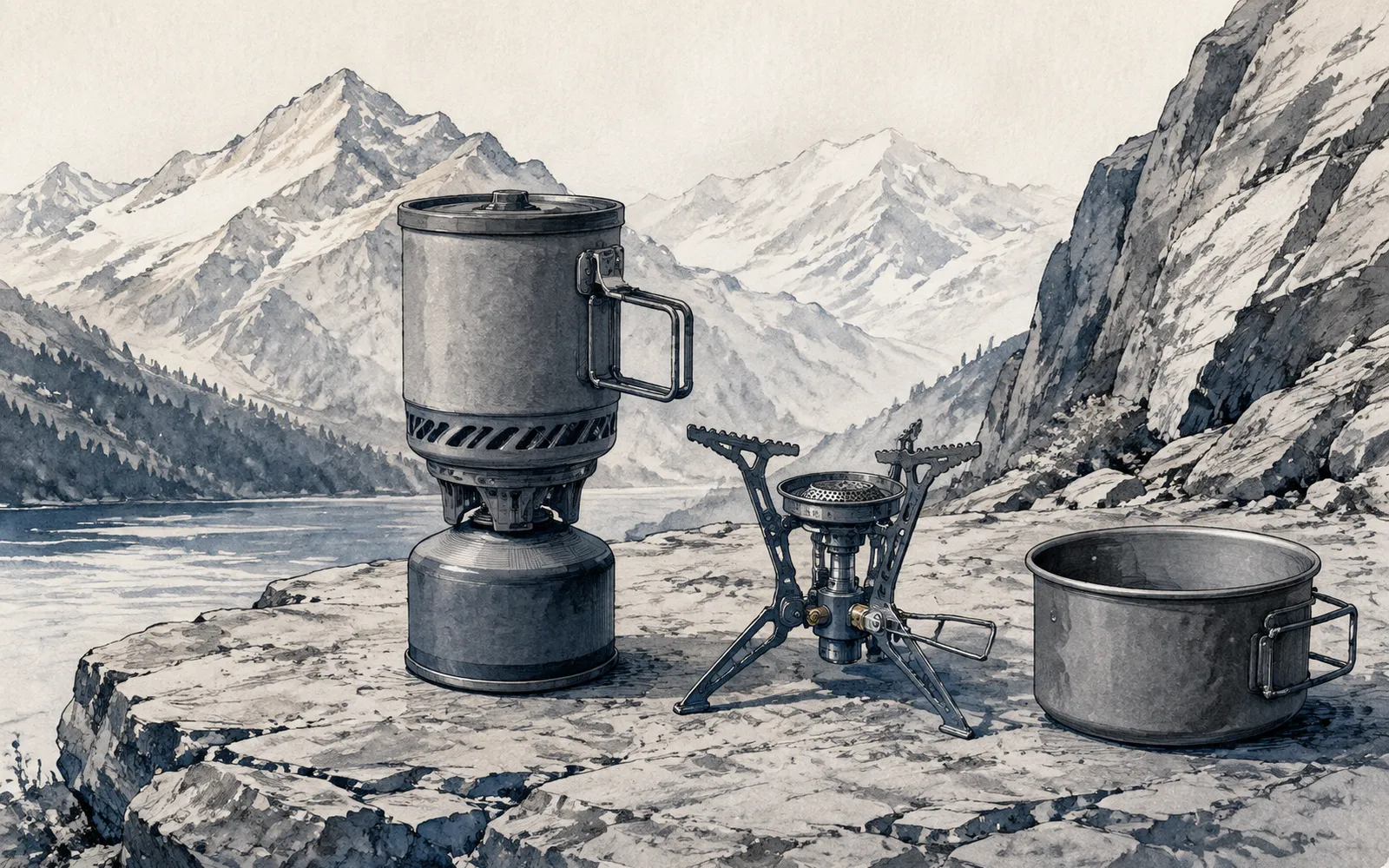
Every stove spec sheet carries a boil time, and it’s the one number most people compare. It’s also the least standardized number in outdoor gear. Two makers can both be telling the truth and still publish figures that can’t be set side by side, because they didn’t boil the same amount of water and didn’t say what temperature they started it at.
So the useful question isn’t which stove is fastest. It’s which maker says what its test looked like.
What does a published boil time actually measure?
Whatever that maker’s own test measured, under conditions it usually doesn’t print. A boil time needs six of them before it means anything: how much water, what temperature the water started at, altitude, ambient air temperature, whether there was wind, and whether the pot had a lid. Canister stoves need a seventh, because output falls as the canister empties and pressure drops.
MSR — a maker we don’t cover — is the one here that publishes its method. Cascade Designs’ support page states that boil tests “start with 1 liter of water that is room temperature and end with a boil at 212F (100C)”, and that “tests are performed at sea level with an ambient temperature of 70F (21C) and no wind.”
The same page says out loud what the rest of the category leaves implied: “some stove manufacturers quote boil times ending at only 203F (95C) to make their stoves appear faster. And some small system stoves quote boil times using only 0.5 liters of water.” Both are happening.
Which conditions does each maker actually state?
Almost none state any. Here’s what the spec pages carry, condition by condition.
| Stove | Published boil time | Volume | Conditions stated | Conditions omitted |
|---|---|---|---|---|
| Jetboil Flash | 120 sec | 0.5 L | “avg. over life of JetPower can” | water temp, altitude, ambient, wind, lid |
| Jetboil MiniMo | 2 min 15 sec | 0.5 L | same canister-average note | all of the above |
| Primus Lite+ | “2.45 min” | 0.5 L | none | all of the above |
| Optimus Crux | 3 min (“average”) | 1 L | that it’s an average | all of the above |
| Optimus Vega | 4–5 min (“average”) | 1 L | an average, as a range | all of the above |
| Esbit solid fuel | “about 5 minutes” | 0.5 L | “depends on the stove and ambient conditions” | numbers for any of them |
| BioLite CampStove 2+ | 4.5 min | 1 L | fire strength, on a separate page | all of the above |
| Stansport Boulder 2-burner | none published | — | — | — |
| MSR (not on our roster) | method only, no time on that page | 1 L | room-temp water to 212F, sea level, 70F ambient, no wind | canister fill, lid |
Two caveats. Primus prints “2.45 min,” which could mean two minutes twenty-seven seconds or two minutes forty-five seconds, and the page doesn’t say which. And Stansport isn’t hiding anything — it publishes burner output, 2 × 25,000 BTU, and claims no boil time, which beats a number with no method behind it.
Why isn’t a half-liter boil time just half of a one-liter boil time?
Nobody publishes both, so there’s no way to check. Doubling a half-liter figure assumes a stove’s warm-up costs scale with the water, and they don’t — burner, pot and heat exchanger come up to temperature once, whatever volume is in the pot. Whether that flatters a stove or penalizes it depends on the design.
Then there’s the finish line. Cascade Designs ends at 212F; a maker that stops at 203F gets a shorter number for the same stove. None of Jetboil, Primus, Optimus, Esbit or BioLite states where its boil time ends.
Why does a heat-exchanger system boil so much faster than an open burner?
Because more of the flame’s heat lands in the water instead of going around the pot. Jetboil describes the FluxRing as “a series of metal fins that expand the surface area exposed to the burner flame” that capture heat and redirect it upward, and claims its systems are “up to 2x more efficient as conventional stoves”. Primus builds a heat exchanger into the Lite pot too.
The power ratings show the gap better than the times do. The Jetboil Flash is rated 5,300 BTU/h, or 1.5 kW, and reaches 0.5 liter in 120 seconds. The Optimus Crux — open burner, no heat exchanger — is rated 3,000 W and 12,000 BTU/h, double the power, for 1 liter in 3 minutes. That’s most of the reason integrated systems look so far ahead on paper: they aren’t burning harder, they’re wasting less.
If you’re boiling to make water safe rather than to cook with it, the stove is only one of the options — see water filter vs purifier.
Is the published fuel figure measured at the same conditions as the boil time?
No, and in most cases it isn’t even the same kind of measurement. Five makers, no two publishing the same kind of number:
- Jetboil publishes liters boiled per canister: 10 liters per 100 g can for the Flash, 12 liters per 100 g for the MiniMo and the Stash — or, in its own words, “a 100-gram canister typically lasts for about 10–12 boils, depending on conditions and usage.”
- Optimus publishes minutes: 90 min from a 230 g cartridge for the Crux, 160 min from the same cartridge for the Vega. Those can’t both be at rated output — the Vega is rated lower (2.6 kW / 6,000 BTU/h against the Crux’s 3.0 kW) yet gets roughly 78 percent more burn time — and neither page says at what setting.
- Esbit publishes burn time per tablet: 5 min for 4 g, 7 min for 5 g, 12 min for 14 g, 15 min for 27 g, plus a calorific value of approximately 28,400 kJ/kg, all flagged as “approx. information - depends on the stove and ambient conditions.”
- Primus publishes no burn time on the Lite or Lite+ pages, and Stansport publishes no boil time.
None of those figures is stated at the same conditions as the boil time beside it, because none of the pages states conditions at all.
Does any standard define how a camping stove’s boil time is measured?
Not one these makers cite. EN 521, the European specification for portable vapor-pressure LPG appliances, covers “the construction and performance characteristics related to safety and the rational use of energy of portable appliances burning liquefied petroleum gases,” with the energy requirements applied to stove burners and deliberately not to grills, lamps, heaters or blowtorches. It’s a safety and construction standard with an efficiency clause, not a boil-time protocol, and no maker here points to it when quoting one.
ISO 19867-1:2018 does define a harmonized laboratory test sequence for cookstove emissions and performance, but its scope is cookstoves “used primarily for cooking or water heating in domestic, small-scale enterprise, and institutional applications,” and it excludes stoves burning LPG, alcohol, plant oil and kerosene.
How much does wind change the answer?
More than anything else on the spec sheet, and nobody publishes a number for it. The only quantification anywhere in this batch is Cascade Designs’ “no wind” — the published times assume none.
What makers offer instead is comparative language. Jetboil says “Stash performs on-par with similar canister stoves in the wind”, and notes a windscreen can “help reduce heat loss, improve boil efficiency, and lessen the likelihood of flame blow-out.” Neither has a figure attached. BioLite is blunter about its own number: with a wood fire, “the time to boil will depend on the strength of the fire you’ve built”.
Cold does get an explanation. Jetboil’s FAQ states that “the pressure in the canister is directly proportional to ambient temperature and as the canister gets colder, the pressure drops and therefore the heat output from the burner drops”, producing longer boil times and harder lighting, and argues altitude “in itself is not so much of a problem.” That’s an explanation, not a correction, and it comes with no revised number.
Does a fast boil time tell you the stove can cook?
No — a boil time actively hides simmer control, which is a separate capability. Jetboil is unusually plain about it: only select models, the TrailCook and Precision Cook lines, are built for simmering, while the Flash and Stash “prioritize speed over cooking control.” The Stash FAQ files that model under “Jetboil’s Fast Boil product category, best for boiling water.”
Optimus shows the tradeoff inside one catalog. The Vega publishes the slowest gas boil time of its stoves, 4 to 5 minutes per liter, and it’s the one described as giving “a precise flame control gets you a slow simmer sans burn”; the faster Polaris Optifuel publishes 3 to 4 minutes per liter at 4,200 W. No simmer measurement is published for any of them — flame control is described, never quantified.
Solid fuel doesn’t offer the choice at all: an Esbit tablet burns its curve and you get what you get. A boil time is a good number for rehydrating a meal and a poor one for frying — the same habit that turns a sleeping pad’s R-value into a whole decision.
The short version
A published boil time is the output of a test the maker didn’t describe, so check the water volume first — Jetboil and Esbit quote half a liter, Optimus and BioLite quote one — and accept that starting temperature, finish temperature, altitude, ambient temperature, wind and lid go unstated by everyone here except MSR. A heat-exchanger system will beat an open burner on that number and use less fuel doing it, which is a genuine advantage when boiling water is the whole job. If you actually cook, distrust the fast number: the makers themselves sort their fast-boil models into a different category from the ones built to simmer. We use and recommend all six of these makers for different work, and not one publishes enough for anyone to declare a winner.
Quick answers
- What water volume do published stove boil times refer to?
- Volumes vary by maker, which is the first reason headline numbers don't compare. Jetboil publishes boil times per 0.5 liter — 120 seconds for the Flash, 2 minutes 15 seconds for the MiniMo. Optimus publishes an average for 1 liter — 3 minutes for the Crux, 4 to 5 minutes for the Vega. Esbit quotes about 5 minutes for 0.5 liter on solid fuel. Check the volume before setting two figures side by side.
- Do stove makers state the conditions their boil times were measured at?
- Mostly not. Of the makers checked for this guide, only MSR publishes a method: 1 liter of room-temperature water taken to 212F at sea level, with an ambient temperature of 70F and no wind. Jetboil adds a single qualifier, that its times are averaged over the life of a JetPower canister. Primus, Optimus and BioLite publish a number with no stated water temperature, altitude, ambient temperature, wind condition or lid.
- Why does a heat-exchanger stove system boil water faster than an open burner?
- More of the flame's heat ends up in the pot instead of passing around it. Jetboil describes its FluxRing as "a series of metal fins that expand the surface area exposed to the burner flame" and claims its systems are "up to 2x more efficient as conventional stoves." The power ratings show the gap: the Jetboil Flash is rated 1.5 kW and publishes 120 seconds for 0.5 liter, while the open-burner Optimus Crux needs 3,000 W to publish 3 minutes for 1 liter.
- Does EN 521 cover camping stove boil-time testing?
- EN 521 covers "the construction and performance characteristics related to safety and the rational use of energy of portable appliances burning liquefied petroleum gases," and its energy requirements apply to stove burners rather than to grills or heaters. It is a safety and construction specification, not a marketing performance test, and no camping stove maker checked for this guide cites it as the basis for a published boil time.
- Does a fast boil time mean a stove can also simmer?
- No, and the makers say so themselves. Jetboil places the Flash and Stash in a fast-boil category and states that only select models — the TrailCook and Precision Cook lines — are built for simmering. Optimus publishes its slowest gas boil time for the Vega, 4 to 5 minutes per liter, and the Vega is the model whose description promises "a precise flame control gets you a slow simmer sans burn."
Brands in this guide
- JetboilThe integrated canister cooking system — and the brand a public company kept when it decided to stop making tents.
- PrimusCamp cooking equipment, from a compact backpacking stove to a full camp kitchen.
- OptimusA Stockholm stove name from 1899, now one of the brands the Swiss Katadyn Group assembled — with a brass stove still in the catalog that predates most of its competitors' companies.
- EsbitHamburg, Germany — a family company founded in 1949, now run by the third generation, whose whole reputation rests on a wax-and-methenamine tablet that burns for twelve minutes.
- BioLiteBrooklyn — a camp stove that charges your phone off its own fire, and a business built so that campers in New York pay for cookstoves in Kenya.
- StansportLos Angeles — a value camping catalog that dates itself to 1949, warrants its website purchases for 90 days, and publishes almost nothing else.