What is actually supposed to be in a 72-hour emergency kit?
Short answer
Ready.gov's basic disaster supplies kit list opens with one gallon of water per person per day, for several days, for drinking and sanitation. Kits sold as 72-hour kits ship four-ounce pouches instead, and the four we counted carry seven to ten percent of that figure. Radio, flashlight, whistle, dust mask, sanitation and tools they generally do carry.
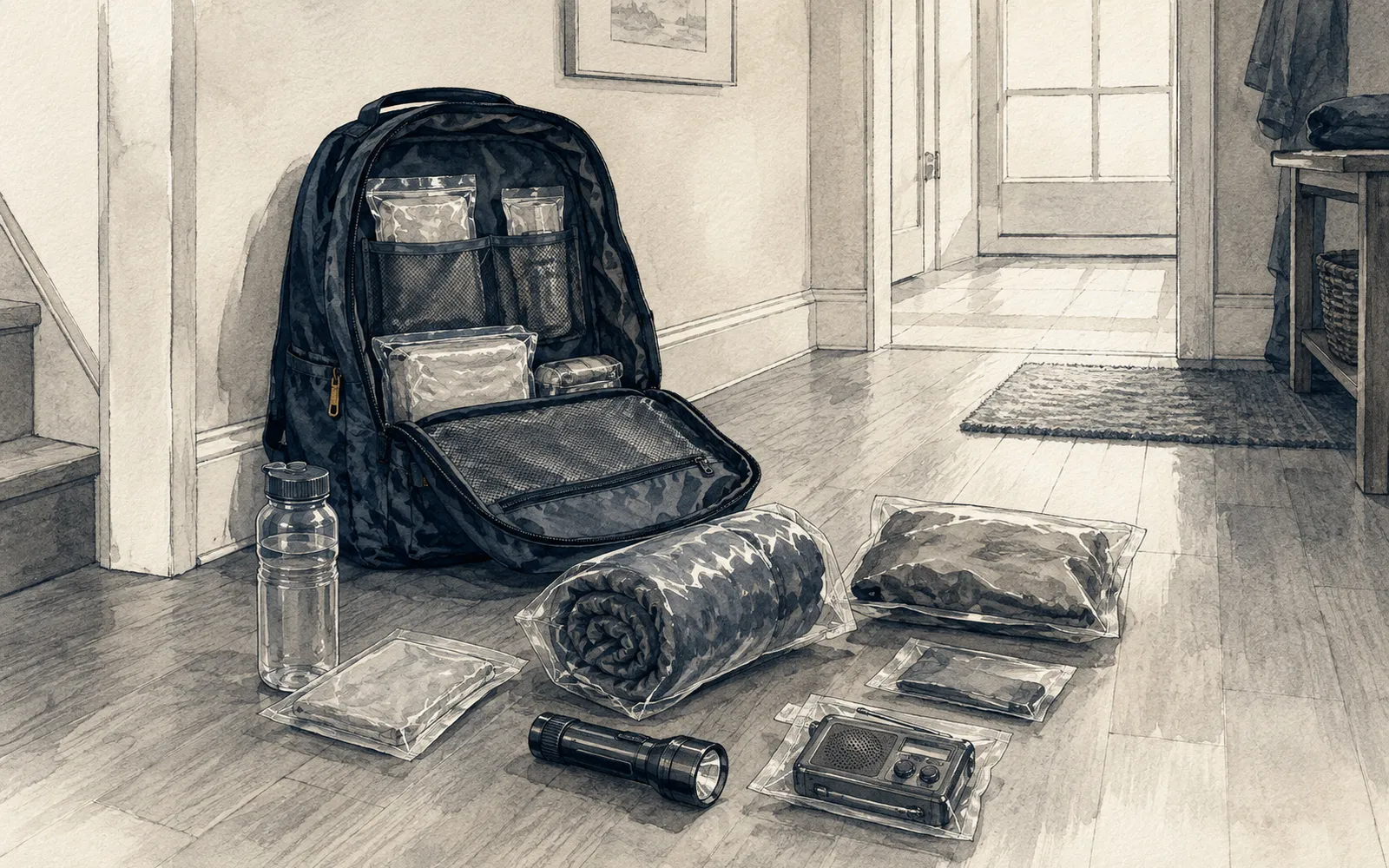
Most categories on this site have no official answer. This one does. The US federal government publishes a disaster supplies list, for free, on a page anyone can read.
So the useful question isn’t “what should be in a kit.” It’s whether the products sold as kits are built against that list. We fetched the list, then counted the contents of four real kits. The non-water items line up well. The water does not line up at all.
What does the published list actually say?
Ready.gov’s basic disaster supplies kit opens with water, and the figure is one gallon per person per day. The line reads: “Water (one gallon per person per day for several days, for drinking and sanitation).”
The rest of the list, verbatim: food (at least a several-day supply of non-perishable food), a battery-powered or hand crank radio and a NOAA Weather Radio with tone alert, flashlight, first aid kit, extra batteries, whistle, dust mask, plastic sheeting, scissors and duct tape, moist towelettes, garbage bags and plastic ties, wrench or pliers, manual can opener, local maps, and a cell phone with chargers and a backup battery.
Note the duration wording, because two federal pages don’t match. Ready.gov says “several days.” FEMA’s own 2020 release, How to Build a Kit for Emergencies, says “at least three days” for both water and food. Same rate, harder floor. We’re flagging the difference rather than picking one.
Ready.gov’s water page adds two qualifiers worth carrying forward: “Children, nursing mothers and sick people may need more water,” and “In very hot temperatures, water needs can double.”
How much water is actually in a kit sold as a 72-hour kit?
Between about seven and ten percent of what the published list calls for. Here is the count, taken from the makers’ own contents lists.
| Kit, as the maker sells it | People / days | Water shipped | Ready.gov figure for that group | Share |
|---|---|---|---|---|
| Ready America 1 Person Elite, 3 Day | 1 / 3 | 9 pouches × 4.225 oz = 38 fl oz | 3 gal = 384 fl oz | ~10% |
| Ready America 2 Person Elite, 3 Day | 2 / 3 | 18 pouches × 4.225 oz = 76 fl oz | 6 gal = 768 fl oz | ~10% |
| Emergency Zone Essentials 72-Hour, 2 Person | 2 / 3 | 12 pouches × 4.2 oz = 50 fl oz | 6 gal = 768 fl oz | ~7% |
| Emergency Zone Family Prep, 4 Person | 4 / 3 | 24 pouches × 4.2 oz = 101 fl oz | 12 gal = 1,536 fl oz | ~7% |
Shares are ours, computed from the makers’ published pouch counts against Ready.gov’s rate at 128 fluid ounces to the US gallon.
A fifth kit makes the point differently. Mayday Industries sells a 13046 Basic 3-Day Kit holding six 4.225 oz water pouches and one 2,400-calorie food bar. How many people it is for is not published, so the share column cannot be computed at all.
The food side is tidier. Ready America ships one 3,600-calorie bar in the one-person kit and three 2,400-calorie bars in the two-person kit; Emergency Zone ships one 3,600-calorie ration per person. All four land on exactly 1,200 calories per person per day, and Emergency Zone states that figure. Ready.gov publishes no calorie figure to compare against — its food page says only “Store at least a several-day supply of non-perishable food.”
Why don’t the kits carry the water?
Because water at that rate is too heavy to put in a backpack, and the maker of the pouches is aiming at a different target.
Run the arithmetic. The US Geological Survey puts a gallon of water at 8.34 pounds. Three people for three days at Ready.gov’s rate is nine gallons — about 75 pounds, before the bag, the food or the radio. Four people for three days is a little over 100 pounds. No shoulder-carried kit holds that.
The pouches themselves reveal the target. Ready America’s 4.225 oz water packet page states the pouches comply with ISO 18813:2022 — which is “Ships and marine technology — Survival equipment for survival craft and rescue boats”, the standard covering what goes into a lifeboat. That is a rationing standard for people awaiting pickup, not a household supply standard. The same page carries the maker’s own daily figure: “Minimum 2 pouches per person per day recommended.” Two pouches is 8.45 fluid ounces. Ready.gov’s figure is 128.
Both numbers are published. They are about fifteen times apart, and no kit page we read acknowledges the gap or tells a buyer to add stored water. That silence is the finding. Ready America does sell the supplement separately — an Aqua Literz is 1,000 ml with a stated 10-year shelf life — but nothing in the kit listing points you there.
If you’re solving the water problem by treating what you find rather than carrying it, “filter” and “purifier” are not interchangeable words: see filter versus purifier. And if you’re judging whether a pack can hold a real supply, the liter figure on a pack is measured in a way that will surprise you.
What do the makers publish about shelf life and rotation?
Water and food, mostly yes. Batteries, no.
Ready America publishes a five-year shelf life for both the 4.225 oz water packets and the food bars, and a storage range of 32°F to 149°F for the water. Emergency Zone’s SOS water ration case says “5 year shelf life from manufacture date” and its food rations carry the same five years. Mayday’s Basic 3-Day Kit page publishes no shelf life for either.
Batteries are the blind spot. Every kit here ships a light and most ship a radio; Emergency Zone lists “Batteries included” on the Family Prep kit. Not one of the four listings publishes a battery expiry, manufacture date or replace-by interval.
Ready.gov’s own maintenance line is short: “Replace expired items as needed. Re-think your needs every year and update your kit as your family’s needs change.” Its water page is more specific about the DIY case — “Water that has not been commercially bottled should be replaced every six months.”
Long-term stored food is a separate market with much longer published numbers. Augason Farms states that “most products last 20-30 years under ideal conditions” while naming its own exceptions — about 10 years for products with eggs or oil, about 5 for granola — and gives a 55°F to 70°F range plus a lot-code method for deriving a best-by date. ReadyWise states that “ReadyWise meals have a shelf life of up to 25 years, depending on storage conditions and product type” at 50–70°F, and publishes no test method. Both are manufacturer claims, not certifications.
Is a 72-hour kit the same as a shelter-in-place supply?
No, and the American Red Cross publishes both figures on the same line while most kit listings publish neither. Its list reads: “Water: one gallon per person, per day (3-day supply for evacuation, 2-week supply for home),” and the identical bracket on food.
That single parenthesis is the distinction the whole category blurs. A backpack is the evacuation object, sized for the three-day column and unable to be sized for the other. The two-week home supply is shelving, containers and rotation — a different purchase, and where stored food and bulk water live.
Ready.gov splits it by location rather than duration: a home kit to grab on the way out, a work kit — “Be prepared to shelter at work for at least 24 hours” — in a “grab and go” case, and a car kit for being stranded. Three kits, three jobs. A listing that says “72-hour kit” and nothing else answers one of them.
What does the published list name that no pre-made kit can contain?
The half that is specific to your household. Ready.gov’s additional supplies list names prescription medications; prescription eyeglasses and contact lens solution; infant formula, bottles, diapers, wipes and diaper rash cream; pet food and extra water for your pet; cash or traveler’s checks; important family documents such as copies of insurance policies, identification and bank account records; a sleeping bag or warm blanket for each person; a complete change of clothing appropriate for your climate and sturdy shoes; matches in a waterproof container; feminine supplies and personal hygiene items; and books, games or puzzles for children. The Red Cross list adds family and emergency contact information, spare keys, a multi-purpose tool, and a line reading “Medications (7-day supply) and medical items.”
None of that can be assembled in a warehouse. It is the buyer’s half of the job, and a sealed backpack tends to feel like it has already been done.
Two contents notes, stated as contents and nothing more. All four kits in the table ship a first aid kit — 33, 53, 107 and 118 pieces — and none of the four listings publishes what is in it. Dedicated makers do: Adventure Medical Kits itemizes its Mountain Series Explorer in full and states it is designed for “4 people up to 7 days,” with no replace-by date on the page. And the emergency blanket the Red Cross list names has published specifications bought on its own: SOL gives its emergency blanket as 2.9 oz, 56 × 84 inches, vacuum-metalized polyethylene, with no shelf life stated. What any first-aid item is for, and how to use it, is outside what this page covers, and guidance on that varies by jurisdiction.
The short version
There is a published list, it is free, and one gallon per person per day is the number on it. Kits sold as 72-hour kits carry roughly seven to ten percent of that, because water at the published rate weighs about 75 pounds for three people over three days and the pouches inside are built to a lifeboat rationing standard. Everything else on the list the kits generally do carry, and the makers publish five-year shelf lives for water and food while publishing nothing for the batteries. Buy the bag if it saves you an afternoon, then add the water, the documents, and the things only you know your household needs.
Quick answers
- How much water does Ready.gov say to store per person?
- Ready.gov's published basic disaster supplies kit list says "Water (one gallon per person per day for several days, for drinking and sanitation)." A 2020 FEMA release states the same rate but pins the duration at "at least three days." Ready.gov adds that children, nursing mothers and sick people may need more, and that in very hot temperatures water needs can double.
- How much water actually ships inside a pre-made 72-hour kit?
- Far less than a gallon per person per day. Pre-made kits are built around sealed water pouches of roughly 4.2 ounces. A two-person, three-day kit typically ships 12 to 18 of them — between 50 and 76 fluid ounces total, where one gallon per person per day for two people over three days would be 768 fluid ounces. That is roughly seven to ten percent.
- What is the difference between a go-bag and a shelter-in-place supply?
- Duration and portability. The American Red Cross publishes both figures on one line: water and food at "3-day supply for evacuation, 2-week supply for home." Ready.gov splits kits by location instead — a home kit ready to grab, a work kit for sheltering at least 24 hours, and a car kit. A backpack cannot hold a two-week home supply, and is not meant to.
- Do emergency kit makers publish a shelf life for water pouches and food bars?
- Some do and some don't, and the gaps are specific. Ready America publishes a five-year shelf life for both its 4.225 oz water packets and its food bars, plus a 32°F to 149°F storage range for the water. Emergency Zone publishes five years from manufacture date for its water rations. Neither publishes an expiry for the batteries that ship inside their kits.
- What does a published emergency supply list include that no pre-made kit can?
- Everything specific to the household. Ready.gov's additional supplies list names prescription medications, prescription eyeglasses and contact lens solution, infant formula, bottles, diapers and wipes, pet food and extra water for pets, cash, copies of insurance policies and identification, a complete change of clothing and sturdy shoes. A sealed kit assembled months ago in a warehouse contains none of it.
Brands in this guide
- Ready AmericaVista, California, from a 1991 garage start — and the rare preparedness company whose spine is hardware you install rather than a bag you store.
- Emergency ZoneA 2007 Idaho family business that became a Utah kit house — and, by its own description, primarily a drop-shipper for other people's storefronts, which is the most useful thing it publishes about itself.
- Mayday IndustriesHuntington Beach kit house with 1,400-plus preparedness items on the shelf, a start date its own pages disagree about, and a customer list we could not verify a single line of.
- Adventure Medical KitsLittleton, New Hampshire, 1989 — first-aid kits laid out by injury rather than by item, built in the same house as SOL, Counter Assault and the consumer QuikClot line.
- SOLSurvive Outdoors Longer — the bivvy-and-signal end of Adventure Ready Brands, Littleton NH, and a brand that publishes almost nothing about its own origins.
- Augason FarmsSalt Lake City, 1972 — a stored-food brand of Blue Chip Group that names its inspecting agencies, its certification scheme, and the products its shelf-life claim does not cover.
- ReadyWiseSalt Lake City — long-term stored food sold on a 25-year number that the company states as a claim and never publishes a test method for.