Which Dakota Lithium battery suits a fishing setup?
Short answer
Match the battery to the equipment before choosing capacity. Dakota’s compact 12V 10Ah model is an electronics option, the heated 100Ah model is deep-cycle only, and the DL+ 135Ah adds starting capability for compatible systems. Voltage, current limits, charger compatibility and physical installation matter as much as amp-hours.
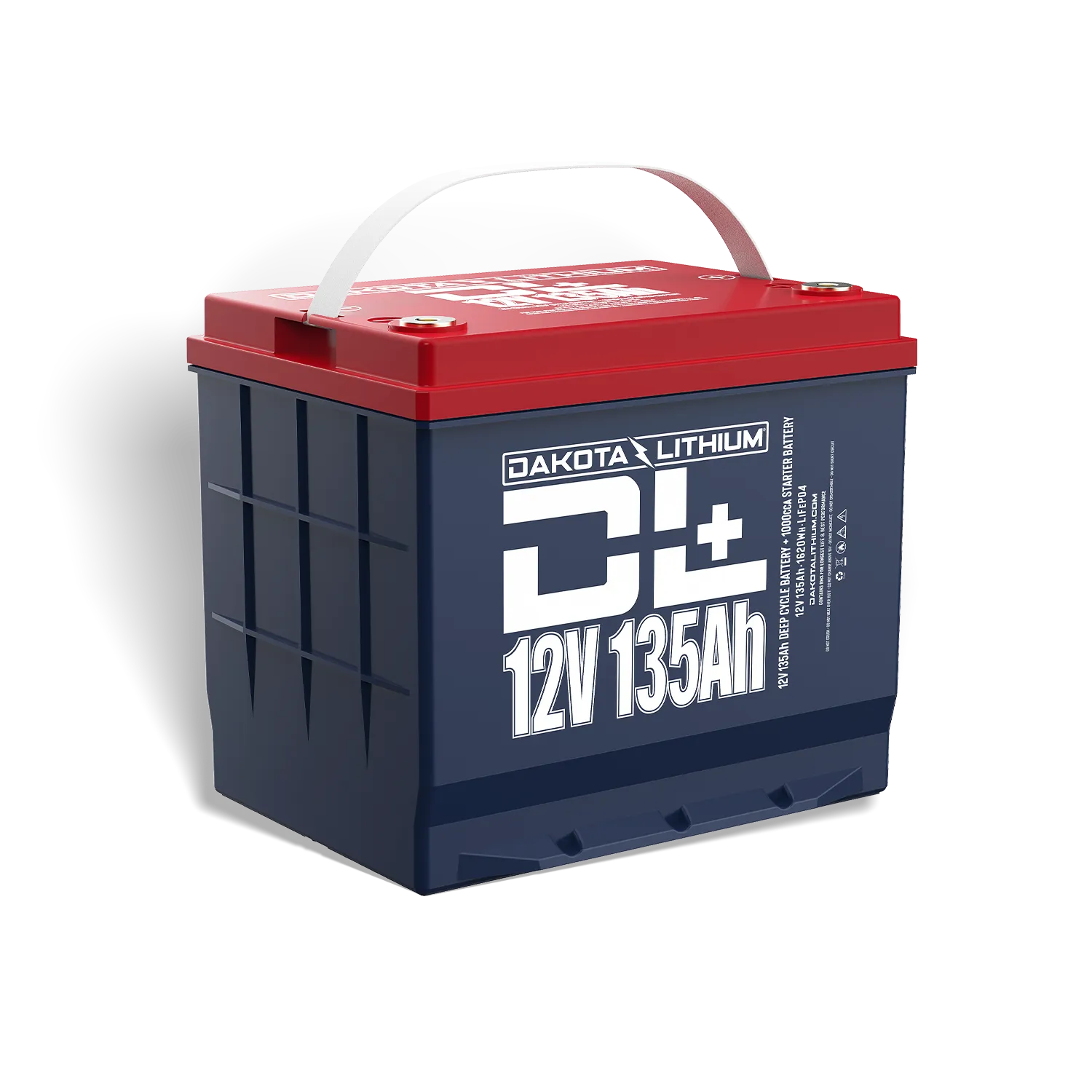
A fish finder, trolling motor and engine starter may all be on the same boat, but they do not make the same demands on a battery. Begin by deciding which circuit you are replacing or building.
Which product family matches the job?
Match the battery to the circuit: Dakota’s 12V 10Ah for low-draw electronics, the 12V 100Ah heated for deep-cycle loads such as a trolling motor, and the DL+ 12V 135Ah heated where one battery may also have to start an engine. Every figure below is Dakota Lithium’s own listing, not an AllEquipped measurement.
| Dakota listing | 12V 10Ah | 12V 100Ah heated | DL+ 12V 135Ah heated |
|---|---|---|---|
| Role to investigate | Dedicated low-draw electronics | Compatible deep-cycle loads | Compatible starting and deep-cycle applications |
| Important distinction | Compact capacity does not establish motor or starting suitability | Dakota explicitly excludes engine starting | Starting and charging approval must be checked for the particular engine |
| Listed capacity | 10Ah (no Wh figure listed) | 100Ah, 1,280Wh | 135Ah, 1,620Wh |
| Max continuous discharge | 20A | 100A | 135A |
| Starting rating | None listed | “Not designed for starting gasoline engines” | “1,000 Cold Cranking Amps (CCA)” lead-acid equivalent; no test standard named |
| Cycle claim | “Up to 80% capacity for 2,000 cycles in recommended conditions” | Same wording, 5,000 cycles | Same wording, 5,000 cycles |
| Charging in the cold | No heater listed; “Avoid charging below 32°F” | Below 0°C, heater warms cells to 5°C (41°F) | Below 0°C, heater warms cells to 0°C/32°F |
| Weight | 2.77lb | 27.55lb | 27.2lb |
| Warranty on the product page | 11 years | 11 years | 11 years (fine print: 3 years for heating) |
Dakota attaches an end-of-life threshold, 80% of capacity, to every cycle figure here. None of the three pages defines “recommended conditions.” And the 135Ah page’s 1,620Wh doesn’t match its own listed 12.8V and 135Ah, which multiply to 1,728Wh by our arithmetic.
The Dakota Lithium brand guide links the exact current product pages and shows the official photographs. These examples are starting points for comparison, not an assertion that one battery fits every fishing setup.
What should be written down first?
Record the device’s required supply voltage, maximum current and planned hours of use. Add the existing charger model, available space and terminal arrangement. For a trolling motor, use the motor manufacturer’s electrical requirements rather than trying to infer them from the boat’s size.
A separate electronics battery can make the power arrangement easier to understand, but cable routing, circuit protection and connections still need to be specified correctly. Buying a battery with more amp-hours does not correct an incompatible voltage or insufficient current rating.
What does heated mean here?
Heated means an internal element warms the cells when the battery is charged below freezing, and Dakota’s two heated models don’t warm them to the same temperature. The 100Ah page says that below 0°C (32°F) “the internal heating element warms the cells to 5°C (41°F)”; the DL+ 135Ah page says its element “will warm the cells to 0°C/32°F.” The 10Ah lists no heater and says “Avoid charging below 32°F.” Those descriptions must be checked against the actual unit being ordered, particularly where older retailer stock uses a similar name. Follow the exact model’s charging-temperature instructions; “cold-weather” branding is not a universal instruction to charge any lithium battery while frozen.
What about an engine-starting replacement?
Of these three, only the DL+ 135Ah is sold for starting; Dakota’s 100Ah page says “Not designed for starting gasoline engines.” The DL+ 135Ah page describes “Multi-purpose use as a deep cycle battery and/or as a starter battery,” limits it to “a max alternator size of 150 amps or less per battery” and says it “Meets Mercury Motors requirements for lithium starter batteries.” It names no test standard or temperature for its 1,000 CCA figure. Dakota’s warranty separately excludes “Using a deep-cycle battery for engine starting where that battery is not specifically designated for starting use.” Ask both the engine supplier and battery manufacturer about the proposed combination, including the charging system. An engine-starting rating alone does not validate every alternator, protection device or wiring arrangement.
How do you finish the shortlist?
Compare exact model specifications and warranty terms, then check current availability. The product pages describe manufacturer-defect coverage; they do not promise a fixed number of fishing seasons or a measured runtime for your electronics. Read the DL+ term closely: the 135Ah page shows an “11 Year Warranty,” while Dakota’s warranty fine print gives a list of DL+ features, starting with “internal heating systems,” a separate “3-year limited warranty.” For a portable unit with built-in outlets instead of an installed battery, read Dakota battery versus PS2400.
The short version
For a fishing setup, start from the circuit, not the amp-hours. Dakota’s 12V 10Ah is an unheated electronics battery with no starting rating, the 12V 100Ah heated is deep-cycle only and not designed for starting engines, and the DL+ 12V 135Ah heated is the one of the three sold for both starting and deep-cycle use, within a 150-amp alternator limit. All three attach an 80% end-of-life threshold to their cycle claims and carry an 11-year headline warranty, but Dakota’s fine print puts the DL+ heater on a three-year term, and the 135Ah’s watt-hour figure doesn’t match its own voltage and capacity. Check the charger, the engine maker’s approval and the exact model before choosing.
Product information checked September 23, 2026, and rechecked October 3, 2026. This is a manufacturer-based selection guide, not an AllEquipped hands-on test. Official photograph used with permission.
Quick answers
- Can the Dakota Lithium 12V 100Ah heated battery start an engine?
- Dakota explicitly identifies the current 12V 100Ah heated model as deep-cycle only and not for engine starting.
- Does 135Ah guarantee that a battery fits my boat?
- No. Check voltage, dimensions, terminals, discharge limits, charging requirements and equipment-manufacturer compatibility for the exact battery.
- Is the heater on the Dakota Lithium DL+ 135Ah covered for the full 11 years?
- No, according to Dakota Lithium's warranty fine print. The DL+ 12V 135Ah product page shows an "11 Year Warranty" and mentions no shorter term, but Dakota's Limited Warranty, effective 5/4/26, gives DL+ batteries an "11-year limited warranty" for the core battery and a separate "3-year limited warranty" for a list of features that begins with "internal heating systems." On that reading, the DL+ 135Ah's heater is a three-year item.
- How many watt-hours does the Dakota Lithium DL+ 135Ah store?
- Dakota Lithium lists the DL+ 12V 135Ah at "1620 Watt-hours (Wh)" on the same page that lists its voltage as "12.8V." Multiplying 12.8V by 135Ah gives 1,728Wh, which is AllEquipped's arithmetic, not a Dakota figure; 1,620Wh is what 12.0V would give. Dakota's 12V 100Ah page is consistent at 12.8V and 1,280Wh. The DL+ 135Ah page doesn't explain the 108Wh gap.
- Is the Dakota Lithium 12V 10Ah battery heated for ice fishing?
- No. The Dakota Lithium 12V 10Ah product page lists no heating element. It names "Ice fishing flashers" among suitable uses, but it also says "Avoid charging below 32°F" and that the battery "should be charged between 32°F to 113°F (0°C to 45°C)." Running electronics on the ice and recharging on the ice are different jobs. Dakota's heated models, such as the 12V 100Ah and the DL+ 12V 135Ah, warm their cells before charging below freezing.