Dakota Lithium battery or PS2400: which fits your trip?
Short answer
Choose a standalone battery when it belongs in a designed electrical system; consider the PS2400 when you need integrated outlets and portable charging in one enclosure. Compare required outputs, energy, lifting weight and charging options. The PS2400 has a different warranty from Dakota’s selected standalone batteries, so read the exact terms.
The question is not simply which box stores more power. It is how much of the surrounding electrical system you want to specify and install.
What does the PS2400 include?
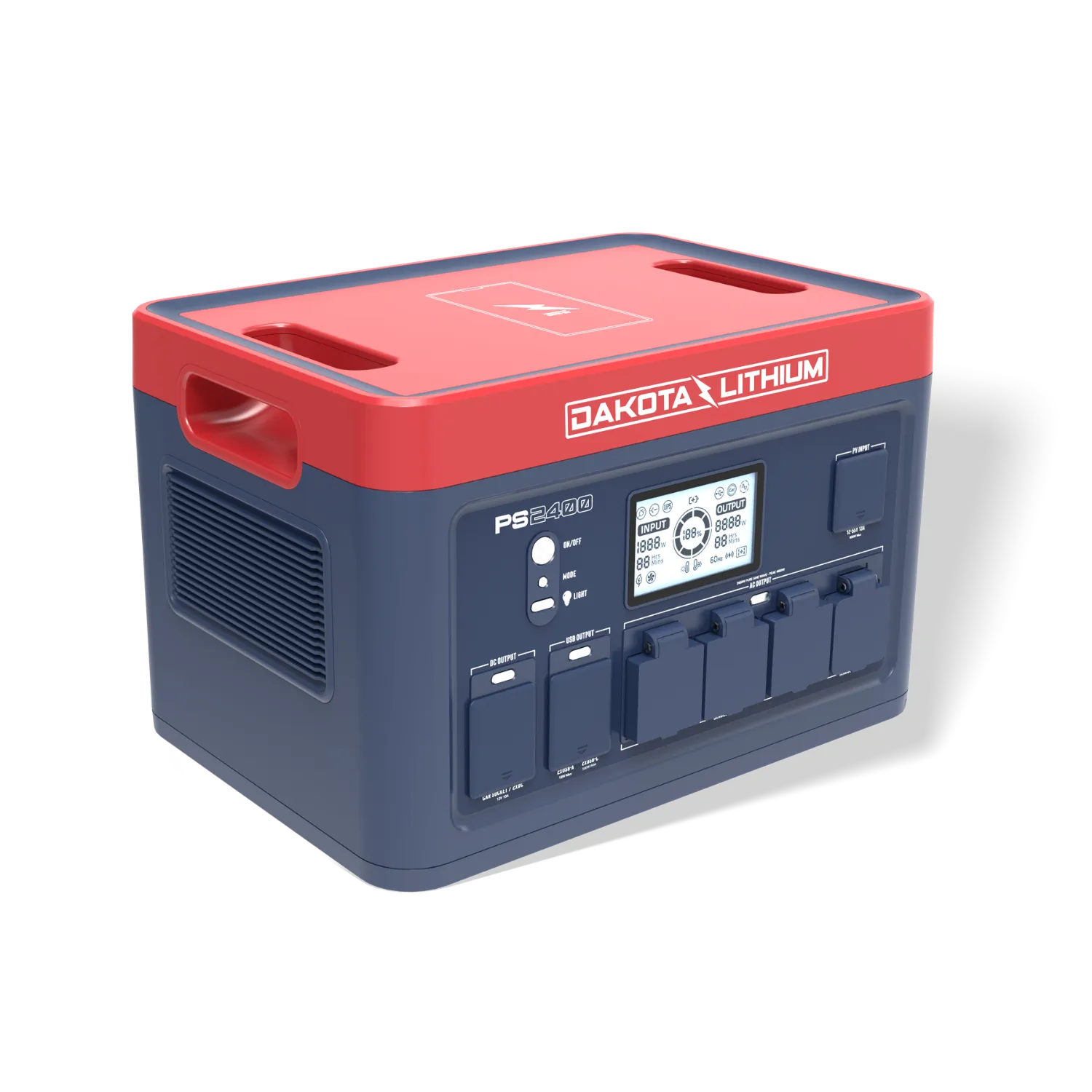
Dakota lists the PS2400 at 2,048Wh of storage and 2,400W AC output, with integrated AC and USB connections and multiple charging inputs. Its listed weight is 55lb. Those numbers describe energy, output and lifting effort respectively; none substitutes for the other.
An integrated unit can be useful when power moves between a campsite, vehicle and another location. Before choosing it, list the actual plugs and power demands of the devices you will connect. The existence of an outlet does not mean every appliance sharing that plug is within the unit’s limits.
How do the PS2400’s listed specs compare with a standalone battery?
On Dakota’s own listings, the PS2400 packs outlets and charging inputs into one 55lb case, while the 12V 100Ah heated battery is a 27.55lb DC component whose page says more about its cells. Every figure below is Dakota Lithium’s published listing, not an AllEquipped measurement.
| Listed specification | PS2400 portable power station | 12V 100Ah Deep Cycle Heated battery |
|---|---|---|
| Stored energy | 2,048Wh (“51.2V/40Ah”) | 1,280Wh (12.8V, 100Ah) |
| Output | 2,400W continuous, 4,800W peak, pure sine wave AC | 100A max continuous, 200A for a 10-second pulse (DC) |
| Built-in outlets | One 30A and three 20A AC outlets (110V), two USB-A, two USB-C (100W max), 12V car socket, two barrel DC, 10W wireless pad | None; M8 bolt terminals |
| Charging | AC input 1,500W; solar 12–75V at 30A max; car 12V/24V, 192W max | Charger sold separately; 50A max, 14.4V recommended |
| Charging temperature | 0° to 40°C (32° to 104°F) | Internal heating warms cells to 5°C (41°F) when below 0°C |
| Weight | 55lb | 27.55lb |
| Cell chemistry named on the page | Not published | LiFePO4 |
| Cycle life | Not published | “Up to 80% capacity for 5,000 cycles in recommended conditions” |
| Warranty | “3 Year Warranty” on the product page; 5 years in Dakota’s warranty fine print | 11 years on the product page and in the fine print |
Two gaps stand out. The PS2400 page publishes no cycle life and names no cell chemistry, where the battery page states both and attaches an 80% end-of-life threshold to its cycle count. And the PS2400 page says two units link “for double the battery capacity (4120Wh),” although double its listed 2,048Wh is 4,096Wh by our arithmetic.
When is a standalone battery the better starting point?
A standalone battery is the better starting point when it will be installed in a designed system, such as a camper or boat that already has charging equipment, protected distribution and suitable DC loads. In that situation, the battery belongs in a larger system and should be selected with the surrounding components.
A bare battery’s purchase price cannot be compared directly with a power station’s price without accounting for the charger, inverter where needed, wiring, protection and installation. Conversely, buying integrated AC equipment may add weight and complexity you do not need for a small DC electronics load.
How do watts and watt-hours change the decision?
Watts describe the rate of power use and watt-hours describe energy over time, so the PS2400’s 2,400W and 2,048Wh figures answer different questions. As a simple example, a steady 100W load running for five hours uses 500Wh before losses. This is arithmetic, not a PS2400 runtime test. Real runtime depends on conversion losses, operating conditions and the load’s behavior.
Check startup demand separately for equipment that needs it. Also check charging-input limits before choosing a solar panel or vehicle connection; a panel’s advertised wattage alone does not establish compatibility.
Is the warranty the same?
No — Dakota gives its standard batteries 11 years and puts the PS2400 in a shorter class, though its own documents disagree on how much shorter. The current PS2400 page specifies a “3 Year Warranty,” and Dakota’s warranty FAQ groups portable power stations under a “3-Year Limited Warranty.” Dakota’s Limited Warranty fine print, effective 5/4/26, gives portable power stations a “5-year limited warranty.” The standalone batteries featured in our Dakota guide advertise 11-year manufacturer-defect coverage, which the fine print confirms for standard batteries. The FAQ also says the current terms apply to products sold “on or after September 1, 2026,” a different date from the PDF’s. We are not resolving that; ask Dakota which term applies to your purchase, and read exclusions and claim requirements for it. Neither period guarantees uninterrupted service for every use case.
What would make the choice clear?
A load list and a charging plan, plus a decision about whether the unit moves or stays installed. If the unit needs to move often, physically assess the listed weight and carrying arrangement. If it will stay installed, cost and design the complete battery system. Our power-station sizing guide provides the next set of questions.
The short version
Choose the PS2400 when you want outlets, AC charging and solar input in one portable case, and a standalone Dakota battery when it is going into a system that already has charging, protection and wiring designed around it. Dakota lists the PS2400 at 2,048Wh and 2,400W — energy and output, not the same number twice — and 55lb to carry. Its product page names no cell chemistry and no cycle life, where the 100Ah battery page publishes both. Warranty is the other split: 11 years for standard batteries, and three or five years for the power station depending on which Dakota document you read. Start from your load list, and get the warranty term for your purchase in writing.
Product information checked September 23, 2026, and rechecked October 3, 2026. This is a manufacturer-based selection guide, not an AllEquipped hands-on test. Official photograph used with permission.
Quick answers
- Does 2,400W mean the PS2400 stores 2,400Wh?
- No. Dakota lists the PS2400 at 2,400W rated AC output and 2,048Wh energy storage. Power and stored energy are different specifications.
- Is Dakota’s PS2400 covered for 11 years?
- No. Dakota Lithium's 11-year term belongs to its standard batteries, not the PS2400. The PS2400 product page states a "3 Year Warranty," and Dakota's warranty FAQ puts portable power stations in its 3-year group, but Dakota's Limited Warranty fine print, effective 5/4/26, lists portable power stations at a "5-year limited warranty." Dakota's own documents disagree, so do not apply a standalone battery warranty to this power station, and get the term for a specific purchase in writing.
- Can two Dakota Lithium PS2400 power stations be linked together?
- Yes, by Dakota Lithium's listing. The PS2400 product page describes the "Ability to Connect 2-In-Parallel: Link two units for double the battery capacity (4120Wh) Parallel cable included." The same page lists one PS2400 at 2,048Wh, and doubling that gives 4,096Wh — AllEquipped's arithmetic, not a Dakota figure — rather than 4,120Wh. Dakota's page does not explain the 24Wh difference, so treat the linked capacity as unconfirmed.
- Does Dakota Lithium publish a cycle life or cell chemistry for the PS2400?
- No. The Dakota Lithium PS2400 product page lists 2,048Wh of storage, its outlets, charging inputs, temperature ranges and a warranty, but gives no cycle count and does not name the cell chemistry. Dakota's 12V 100Ah heated battery page does both: it names LiFePO4 and states "Up to 80% capacity for 5,000 cycles in recommended conditions," a cycle claim with its end-of-life threshold attached. The power station's page publishes neither.
- What charging temperature range does Dakota Lithium list for the PS2400?
- Dakota Lithium lists the PS2400's charging temperature as "0° to 40°C / 32° to 104°F," the same range it gives for operating, with storage rated from -20°C to 45°C. The PS2400 product page describes no heating feature. Dakota's 12V 100Ah heated battery works differently: below freezing, "the internal heating element warms the cells to 5°C (41°F)." A heated battery's cold-charging behavior does not carry over to the power station.