How should you read COAST output and runtime figures?
Short answer
Read output and runtime from the same operating mode. COAST’s current XP11R lists 3,000 lumens in Turbo, while its 200-hour runtime belongs to 12-lumen Moon Glow. These are separate specifications. Use the mode table, the exact model version and the test conditions when comparing lights.
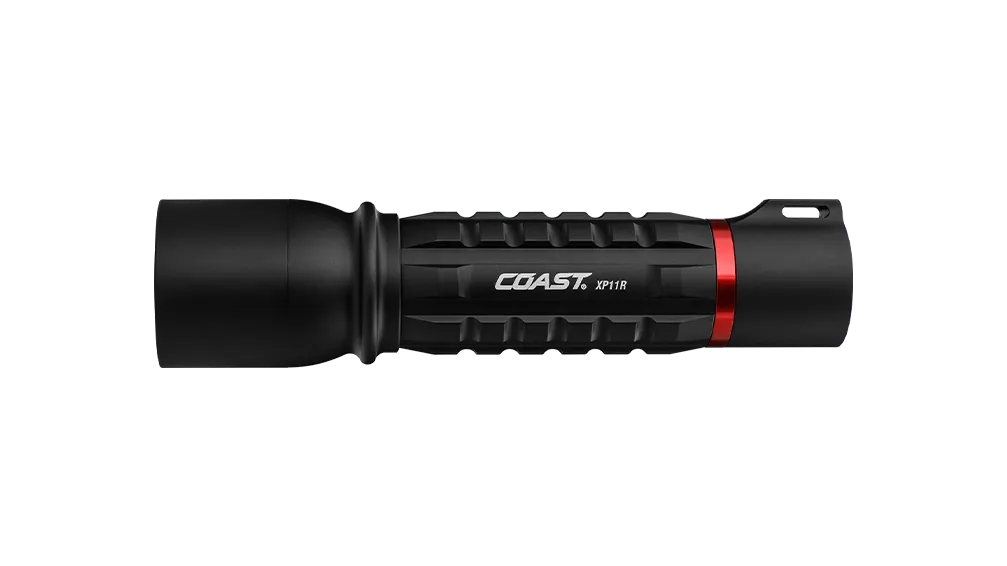
A flashlight’s headline numbers answer different questions. Maximum output tells you about its brightest stated mode. Maximum runtime tells you how long another, often much dimmer, mode is rated to operate.
What does the XP11R table actually say?
The XP11R table gives output, runtime and beam distance for each mode — and no runtime at all for 3,000-lumen Turbo. The current XP11R listing publishes the following mode-specific figures:
| Mode | Listed output | Listed runtime | Listed beam distance |
|---|---|---|---|
| Turbo | 3,000 lumens | No runtime given in the displayed mode table | 280 m |
| High | 1,100 lumens | 4.25 hours | 165 m |
| Medium | 380 lumens | 7.5 hours | 100 m |
| Low | 160 lumens | 17 hours | 60 m |
| Moon Glow | 12 lumens | 200 hours | 16 m |
These are manufacturer specifications, not our measurements. In particular, the table does not say that the light sustains 3,000 lumens for 200 hours. Nor does a listed runtime alone establish that output stays flat from beginning to end.
The missing Turbo runtime is the kind of gap the portable-light industry’s own standard now addresses. PLATO’s 2025 revision of ANSI/PLATO FL 1 names these modes Short-Duration Elevated Brightness, measures their output, beam distance and peak beam intensity “between one and 10 seconds,” and states that “Runtime must always be included when reporting an SDEB mode.” The XP11R page doesn’t say which edition of FL 1, if any, its figures follow, so treat the gap as a question to ask rather than a finding against the light.
How would you compare lights for a task?
Decide what the light has to illuminate and for how long. Then compare the mode that is likely to serve that task, including its beam pattern. A focused beam and a broad flood distribute light differently, even at the same total output.
For checking something briefly, maximum output may be relevant. For a longer task, the usable setting, the charging arrangement and the plan for depleted batteries become more important. If a precise sustained level matters, look for a measured output-over-time curve or perform a controlled test rather than inferring one from the box.
The same habit applies across COAST’s range. The RL35R headlamp page lists a maximum runtime of 83 hours, while its per-mode rows give 2.5 hours combined, 6.5 hours flood and 6 hours spot. None of the listed mode rows carries the 83-hour figure, and the page doesn’t say which setting does.
What if a retailer lists different numbers?
Confirm the exact model revision and compare its packaging and manual with the manufacturer’s current page. Reused family names, older stock or incomplete retailer text can complicate comparisons. A discrepancy does not, by itself, prove which explanation applies.
The same care applies to battery type. A runtime measured with the supplied rechargeable battery should not automatically be assigned to an alternative set of disposable cells unless the manufacturer specifies that result. The XP11R lists “ZX1000 or 3 x AAA (Alkaline Not Included)” and publishes a single set of runtimes without naming the battery behind them.
Does beam distance tell you the whole story?
No — a maximum distance figure does not describe how evenly the near field is lit or how easy the controls are to use. Treat output, beam distance, runtime and handling as separate parts of the decision. Our headlamp lumen guide gives the broader measurement context.
For a product shortlist, return to COAST lights for camp and work or the COAST brand guide. Choose the operating mode and format you need rather than a combination of maxima the product never promises simultaneously.
The short version
Read every COAST figure against the mode it belongs to. On the XP11R, 3,000 lumens is Turbo, the 200-hour runtime is 12-lumen Moon Glow, and Turbo has no runtime listed at all — a gap the 2025 edition of ANSI/PLATO FL 1 now asks makers to fill for short-duration modes. The RL35R shows the same pattern from the other side: an 83-hour maximum that none of its listed mode rows carries. The XP11R takes a ZX1000 pack or three AAAs, but COAST publishes one set of runtimes without naming the battery behind it. Compare lights by the mode your task needs, its beam pattern and your recharge plan, and treat each number as COAST’s listing rather than a measured result.
Product information checked September 23, 2026, and rechecked October 3, 2026. This is a manufacturer-based selection guide, not an AllEquipped hands-on test. Official photograph used with permission.
Quick answers
- Will the XP11R run for 200 hours at 3,000 lumens?
- No. The current COAST XP11R page assigns 3,000 lumens to Turbo and 200 hours to the 12-lumen Moon Glow mode.
- Does a listed runtime guarantee constant brightness?
- A runtime figure alone does not establish constant output. Consult the test conditions and any available output-over-time measurements.
- How long does the COAST XP11R run in Turbo mode?
- COAST doesn't say. The XP11R page lists Turbo at 3,000 lumens and 280 meters of beam distance, with no runtime. PLATO's revised ANSI/PLATO FL 1-2025 standard calls turbo and boost modes Short-Duration Elevated Brightness and states that "Runtime must always be included when reporting an SDEB mode." The XP11R page doesn't say which edition of FL 1, if any, its figures follow.
- Do the COAST XP11R runtimes apply when it runs on AAA batteries?
- COAST doesn't say. The XP11R battery line reads "ZX1000 or 3 x AAA (Alkaline Not Included)," and the page publishes one set of runtimes, from 4.25 hours on high to 200 hours in Moon Glow, without stating which battery produced them. No separate output or runtime figure for three AAA batteries is listed on the XP11R page.
- What is the capacity of the COAST ZX1000 battery used in the XP11R?
- COAST lists the ZX1000 as a 3.7 V lithium-ion battery of 5000 mAh, with USB-C charging and an "Approx Charge Time 5 h." By our arithmetic that is about 18.5 watt-hours; COAST doesn't publish a watt-hour figure. The ZX1000 page lists the XP11R among compatible lights and states no cycle life and no warranty term.