COAST CL40R vs EAL55R: work light or camp lantern?
Short answer
Choose the CL40R for a fixed work area with a suitable clamping or standing position. Choose the EAL55R for shared area lighting with selectable coverage and light color. Their output numbers do not describe the same beam pattern, so begin with placement and the task before comparing brightness or battery life.
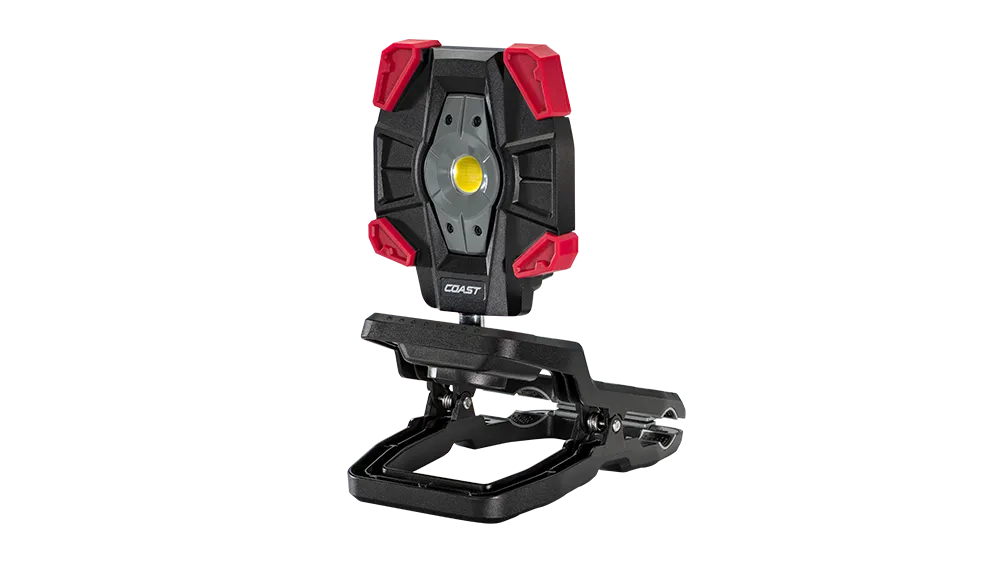
Researched comparison based on current manufacturer information. These products have not been hands-on tested by AllEquipped.
What job suits the CL40R?
The CL40R suits a stationary task where you can position a flood light independently of your body. COAST specifies a clamp that doubles as a stand, a built-in rechargeable battery and USB-C charging.
Its published mode table lists high at 3,900 lumens for 4.75 hours, medium at 2,140 lumens for 8.75 hours and low at 1,190 lumens for 16 hours. These are manufacturer ratings, not our measurements of sustained output. The listed weight is 59.33oz.
For a repair or workbench, first identify a secure position that avoids casting your own shadow across the job. If you move between several locations, a mounted light may need repeated repositioning. The smaller CL20R review gives another option in the same format.
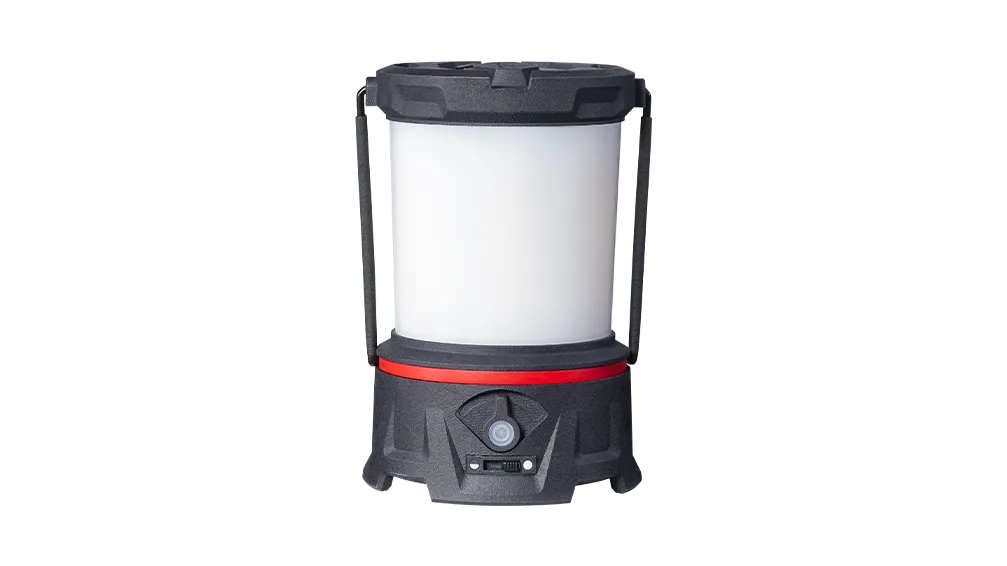
COAST EAL55R. © COAST. Used with permission..
What does the EAL55R do differently?
The EAL55R is a lantern for spreading light around a shared space. COAST lists selectable 180-degree or 360-degree white-light coverage, warm/cool/red modes and a brightness dial. Its current page gives a maximum of 3,000 lumens and a separate maximum runtime of 100 hours; it does not pair those maxima as one setting.
The page lists rechargeable and AA battery options — its battery line reads “Built-In ZITHION-X™, 6 x AA, or ZX915”. Confirm the exact supplied battery and which runtime applies to your chosen configuration. We would not assign one advertised maximum to every battery option or color mode.
How do the two compare on COAST’s own listings?
On COAST’s listings the CL40R is the brighter, heavier light with a full mode table, while the EAL55R lists the longer maximum runtime and the only alternative-battery option. Every figure below is the manufacturer’s listing, not our measurement.
| Listed specification | CL40R | EAL55R |
|---|---|---|
| Maximum output | 3,900 lm (high) | 3,000 lm |
| Output and runtime by mode | High 3,900 lm, 4.75 h; medium 2,140 lm, 8.75 h; low 1,190 lm, 16 h | Not published by mode |
| Maximum runtime | 16 h (low) | 100 h (mode and battery not stated) |
| Maximum beam distance | 87 m (high) | 44 m |
| Beam | “ULTRA VIEW™ FLOOD”, fixed; “360° ROTATION” | 180 or 360 degrees in white; warm, cool, red, flashing red |
| Battery | “Built-In ZITHION™ Rechargeable” | “Built-In ZITHION-X™, 6 x AA, or ZX915” |
| Battery capacity | Not published | Not on the lantern page; ZX915 pack listed at 4400 mAh, 7.4 V |
| Charging | USB-C | ZX915 pack lists “USB-C in/out” |
| Power out to other devices | USB-C or USB-A port | USB-C or USB-A port |
| Water and dust | IP54 | IP54 |
| Weight | 59.33 oz | “42.4 OZ” in the page summary; no weight row in the spec table |
| Dimensions | 9.75 in long, 4.75 in wide, 11.75 in high | Not published |
| Peak beam intensity | Not published | Not published |
| Test standard named | None | None |
Two wording points on the EAL55R page are worth reading closely. The battery line calls the rechargeable “Built-In,” while the RECHARGEABLE+™ feature text says you can “swap in disposable batteries” — and that feature text describes the lantern as a “flashlight.” The page doesn’t explain how the built-in battery and the separate ZX915 pack relate.
How would you choose for a camper?
Choose around where the light will live. A clamp lamp may suit a repair beside a parked vehicle; a lantern may better suit a table with several people around it. For a small sleeping space, look for usable dimming and comfortable placement rather than maximizing output.
Directional coverage can help keep a light aimed toward the task. It does not remove the need to consider glare and nearby campers. We have not compared either product’s lowest usable setting, controls or light quality in person.
What should you check before a longer session?
Check the operating mode, battery arrangement and recharge opportunity together. Both product pages list IP54 and power-bank capability, but charging another device uses energy you might otherwise reserve for lighting.
If a dependable brightness level is important to the work, ask for an output-over-time test or test the exact setup before relying on it. Our COAST runtime guide explains why a maximum lumen figure and a maximum runtime should not be combined into a promise the manufacturer never made.
Explore the Coast brand guide or browse more gear with official photos.
The short version
Pick by where the light will sit, not by the bigger number. The CL40R is a fixed-flood clamp light for one work area: COAST lists 3,900 lumens on high for 4.75 hours and 16 hours only on the 1,190-lumen low setting, at 59.33 oz with a built-in battery. The EAL55R is a lantern for a shared table or camp, with 180- or 360-degree white light, warm, cool and red modes, and a choice of rechargeable or six AA batteries — but its page publishes only maxima, 3,000 lumens and 100 hours, without saying which mode or battery those belong to. Both list IP54 and a power-out port, and neither publishes peak beam intensity or names a test standard.
Specifications checked September 24, 2026, and rechecked October 3, 2026. Official photographs used with permission.
Quick answers
- Which COAST light offers 180-degree and 360-degree coverage?
- COAST's EAL55R lantern offers selectable 180-degree or 360-degree lighting in white mode. The COAST CL40R is a fixed flood work light.
- Does the CL40R provide 3,900 lumens for 16 hours?
- No. For the CL40R, COAST lists high at 3,900 lumens for 4.75 hours and low at 1,190 lumens for 16 hours.
- Can the COAST EAL55R lantern run on AA batteries?
- Yes, according to COAST. The EAL55R page lists the battery as "Built-In ZITHION-X™, 6 x AA, or ZX915" and says you can "swap in disposable batteries when it suits your needs." The page gives a single maximum runtime of 100 hours and no separate runtime for six AA cells, and it doesn't say whether AA batteries come in the box.
- How much do the COAST CL40R and EAL55R weigh?
- COAST lists the CL40R clamp light at 59.33 oz in its specification table. The EAL55R lantern shows "42.4 OZ" in the product summary at the top of its page, but its specification table has no weight row and no dimensions. By our arithmetic, that is about 3.7 lb for the CL40R and about 2.7 lb for the EAL55R.
- Does COAST publish battery capacity for the CL40R or the EAL55R?
- Only for the EAL55R's separate ZX915 pack, on that battery's own page. COAST lists the ZX915 ZITHION-X™ battery, compatible with the EAL55R, at 4400 mAh and 7.4 V, with no charge time or cycle life. Neither the EAL55R page nor the CL40R page states a capacity, and the CL40R's "Built-In ZITHION™ Rechargeable" battery has no capacity figure anywhere we found.