What do IP ratings mean on a flashlight or headlamp?
Short answer
The first digit is protection against solids and dust, on a scale of 0 to 6. The second is protection against water, on a scale of 0 to 9. An X means that digit was not tested, not that it scored zero. Two traps matter: a higher second digit does not automatically include the lower ones, so IPX7 immersion does not cover IPX6 water jets unless the product is dual-coded; and IPX8 depth and duration are agreed by the manufacturer, not fixed by the standard.
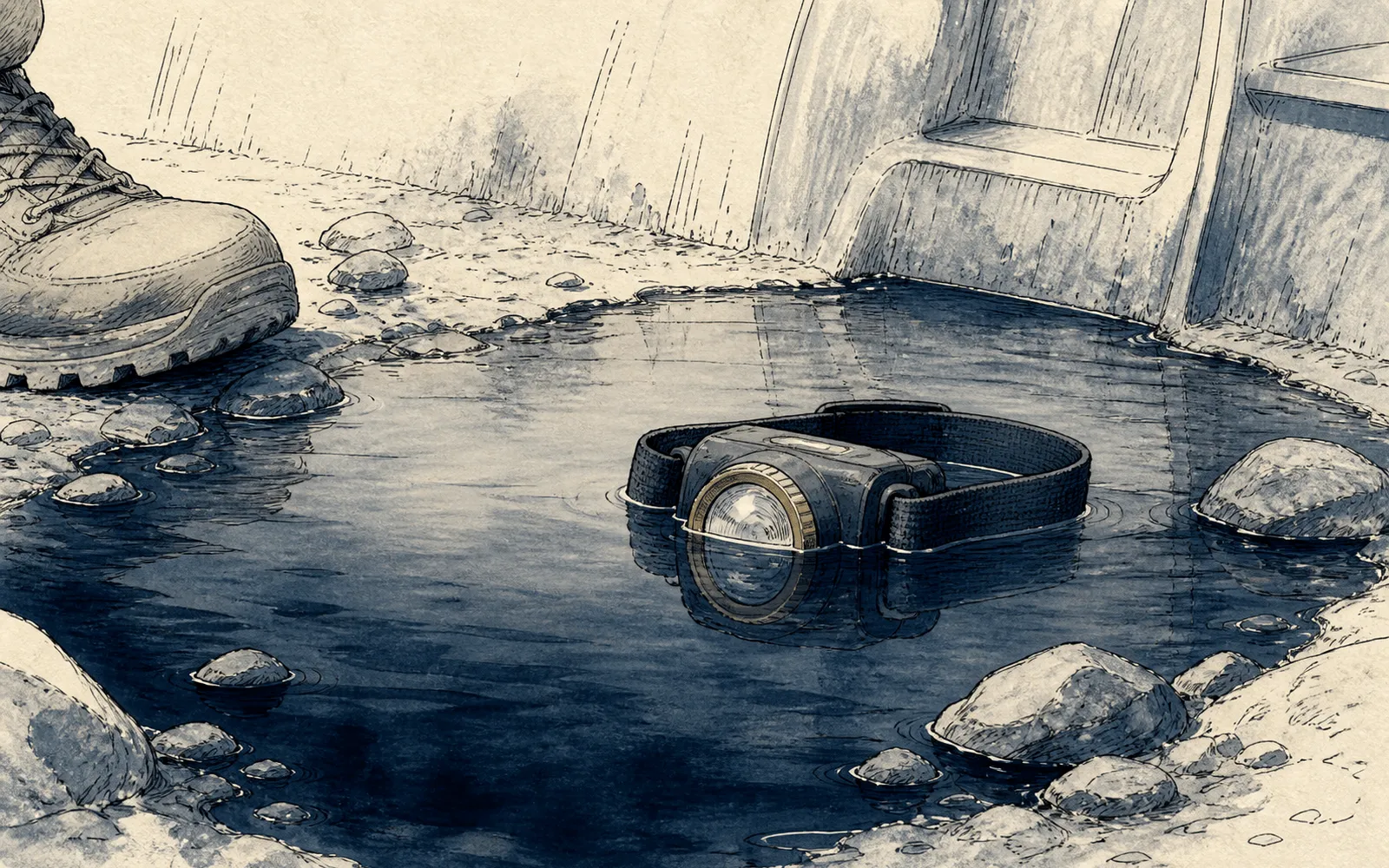
IP ratings look like the most objective spec on a flashlight box: a standard, a number, no marketing. They are objective. They are also routinely misread in a way that puts people’s kit in situations it was never tested for.
What do the two digits mean?
First digit: solids and dust, 0 to 6. Second digit: water, 0 to 9. The standard is IEC 60529, currently Edition 2.2, published 2013.
The IEC’s own summary is short enough to quote: the first numeral refers to protection against solid objects on a scale from 0 to 6, where 6 is no ingress of dust; the second rates protection against liquids on a scale from 0 to 9, where 9 is high-pressure hot water from different angles.
| Second digit | What it means | Test in brief |
|---|---|---|
| X | Not tested or not declared | — |
| 4 | Splashing | Water from all directions, 10 min |
| 5 | Water jets | 6.3 mm nozzle, 12.5 l/min, from 2.5–3 m |
| 6 | Powerful water jets | 12.5 mm nozzle, 100 l/min |
| 7 | Immersion to 1 m | 30 minutes |
| 8 | Continuous immersion | Depth and time set by the manufacturer |
That bottom row is the first thing worth internalising.
Does IPX7 cover a pressure washer?
No — and this is the misreading that actually costs people equipment.
For the spray range, a higher number does include the lower ones: meeting IPX6 satisfies IPX1 through IPX5. But the immersion ratings are a separate branch. An enclosure rated 7 or 8 is unsuitable for exposure to water jets unless it is dual coded — you will see this written as IPX5/IPX7 or IP66/IP68 on products that have passed both.
The reason is physical rather than bureaucratic. Immersion applies uniform static pressure from every direction at once. A jet applies directional dynamic pressure with impact force behind it, and it finds seams that static pressure never loads. A gasket that holds a meter of still water can be walked open by a hose.
So: a headlamp rated IPX7 has not been shown to survive being hosed down. If you wash your kit, or work where it will be sprayed, look for a dual code.
What does IPX8 actually promise?
Whatever the manufacturer says it promises. This is written into the standard rather than being a loophole: for IPX8, the depth and duration are agreed between manufacturer and user, subject only to being more severe than IPX7.
Four independent sources say the same thing, including two manufacturers. Fenix states IPX8 means submersion deeper than one meter for extended periods, specified by the manufacturer. Ledlenser’s own advisor page describes IPX8 as protection against permanent immersion where the exact conditions are specified by the manufacturer, and offers two meters only as an example.
The practical consequence: an unqualified “IP68” claim with no depth and no time is not a comparable specification. Two products both marked IP68 may have been tested to wildly different conditions. When it matters, look for the stated depth and duration, not the code.
A live example: the same product, two ratings
We ran into this checking the roster, and it is a clean illustration of why the code alone isn’t enough.
The Ledlenser EXH8 is a single product with a single article number, 501017. As of August 2026:
- Ledlenser’s global site lists water and dust resistance as IP68.
- Ledlenser’s UK, Hong Kong and Australia sites list the same product as IP66.
Every other specification agrees across all four — 180 and 50 lumens, 120 and 65 meters, 15 and 40 hours, three AA cells, 345 g, one-meter drop, −20 to 40 °C, and the same explosive-atmosphere zone rating.
This is not a case of one site quoting a conservative tier. Under IEC 60529, IP66 and IP68 are disjoint claims — powerful water jets versus continuous immersion — so neither supersedes the other. One of the two pages is wrong, and a buyer cannot tell which from the outside.
We flag it not to single out one manufacturer, whose hazardous-location certifications are among the better-documented on our roster, but because it is the clearest available demonstration of the general rule: the rating belongs to a test on a model, and you should find out which test.
What ratings do real lights carry?
Worth seeing, because the spread surprises people:
- IPX4 (splashing): Petzl ACTIK CORE and SWIFT RL, Maglite ML300L, BioLite 800 Pro
- IP54: COAST TP9R
- IP66: Nitecore UT27
- IPX7 / IP67: Streamlight Sidewinder Compact II and Survivor X, Nightstick XPP-5454G, Black Diamond Storm 500-R
- IP68: Fenix HM65R V2.0, PD35 V3.0, HT30R
Note where the premium mountaineering headlamps sit. IPX4 is splash resistance — fine for rain, not for dropping in a stream. Manufacturers describing an IPX4 lamp as “weather resistant” are being accurate; buyers reading that as waterproof are not.
What the rating does not tell you
Impact. Drop resistance is measured separately under ANSI FL 1, and a light can be waterproof and fragile. Streamlight’s Sidewinder Compact II publishes a three-meter multi-orientation impact test alongside its IPX7; Ledlenser and Nightstick both publish drop heights.
Salt. IEC 60529’s immersion tests are not corrosion tests. A light that survives a meter of fresh water for half an hour has told you nothing about six months of salt spray, which is why marine and offshore use is its own conversation.
Whether the seal is still good. Every rating is a test on a new product. O-rings age, get dirt in them, and get pinched during battery changes — and nothing about the number on the box survives a cross-threaded tailcap.
How to read a spec line in ten seconds
- Is there an X? Then that half was not tested. Fine, but know it.
- Is the second digit 7 or 8 without a 5 or 6 alongside it? Then it has not been tested against jets.
- Is it 8 with no depth or duration published? Then the claim is not comparable to another 8.
- Is the number a regional page or the datasheet? As above — worth checking twice on anything you’re relying on.
The IP code is genuinely useful. It just answers a narrower question than the two digits suggest, and the narrowness is where people get caught.
Quick answers
- Does IPX7 mean a light can survive a pressure washer?
- No. IPX7 covers immersion in one meter of water for 30 minutes, which is static pressure. Water jets are tested separately as IPX5 and IPX6, which apply directional impact force. A product rated IPX7 is unsuitable for exposure to water jets unless it is dual coded, such as IPX6/IPX7. This is the single most common misreading of the IP code.
- What does IPX8 actually guarantee?
- Less than most buyers assume. Under IEC 60529, IPX8 means immersion under conditions more severe than IPX7, with the depth and duration agreed between manufacturer and user rather than fixed by the standard. An unqualified IPX8 or IP68 claim with no stated depth and time is therefore not directly comparable between products. Ledlenser's own explanation gives two meters as an example of a manufacturer specification, not as a requirement.
- What does the X in IPX7 mean?
- That the digit was not tested or not declared, not that the product scored zero. IPX7 means water protection was tested to level 7 and solid-particle protection was not rated. IP67 means both were tested — 6 for dust tight and 7 for immersion. A light with an X in the first position may well resist dust; the manufacturer simply has not made a claim about it.
- Is IP68 always better than IP66?
- Not straightforwardly, because they describe different tests. IP66 means protection against powerful water jets; IP68 means protection against continuous immersion under manufacturer-specified conditions. Under IEC 60529 the immersion ratings do not automatically include the jet ratings, so a device rated IP68 alone has not necessarily been shown to withstand a jet. Where the two claims appear on the same product, they are not tiers of one scale.
- Is IP69 the same as IP69K?
- No. IP69 is defined in IEC 60529 and IP69K in ISO 20653, which was written for road vehicles. Both use water at around 80 degrees Celsius, but the tests differ — IEC 60529 specifies the water-jet force at a nozzle distance of 175 plus or minus 25 millimeters, while ISO 20653 specifies pressure at 100 to 150 millimeters. They are not interchangeable claims.
Brands in this guide
- LedlenserTwo brothers, a thousand Deutschmarks and a rejected bank loan — now a German brand with a Chinese factory and the only certified explosion-proof headlamps in this group.
- StreamlightEagleville, Pennsylvania, since 1973 — the light that carries the certification when SureFire money isn't on the table.
- FenixShenzhen since 2001 — the best lumens per dollar in this group, and the clearest example of why lumens per dollar isn't the whole question.
- NightstickWylie, Texas — the lighting brand that competes on certification paperwork, and usually wins on price while it's at it.
- Black DiamondClimbing equipment and mountain lighting, with practical choices for the crag, trail and camp.
- PetzlFifty years of French vertical-safety engineering, and the spine of most rope access kits — including ours.
- NitecoreGuangzhou since 2007 — the brand that got into your kit through the battery charger, not the flashlight.
- COASTFocusable handhelds, rechargeable headlamps and area lights for everyday work and camp.