Does rope lose strength when it's wet? Yes — and the honest number depends what you're measuring
Wet nylon loses about 10–15% of its tensile strength and up to 70% of its dynamic fall capacity. Those aren't the same claim. Sterling's HTP Static is built entirely from the fiber that sidesteps the problem.
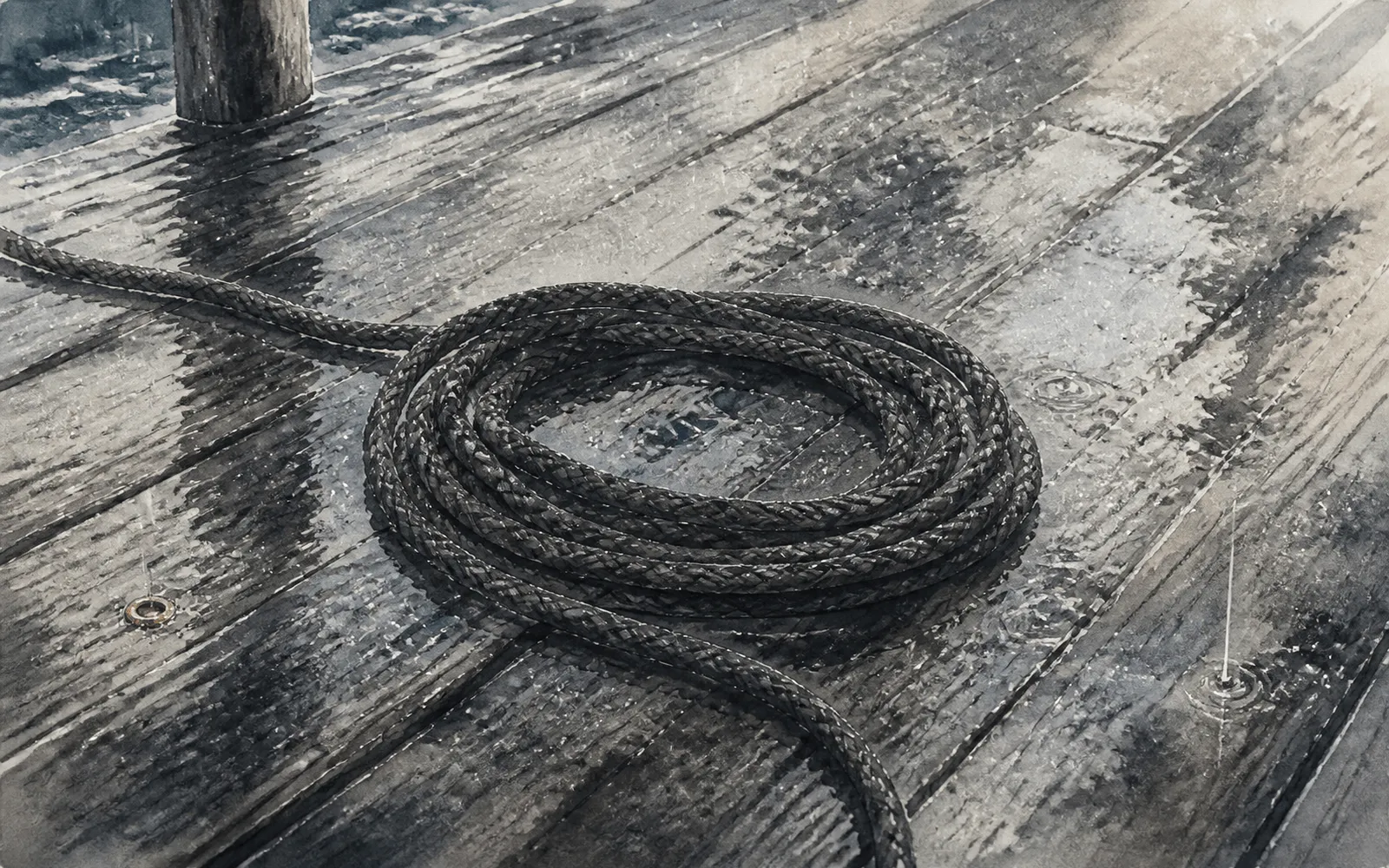
Ask whether a wet rope is weaker and you’ll get numbers between 10% and 70%, all from credible sources, all correct. They’re measuring different things, and the gap between them is where most of the useful understanding lives.
Does nylon rope lose strength when it gets wet?
Yes — roughly 10 to 15% of tensile strength. The Rope Fiber Selection Guide, a widely reproduced industry fiber-property chart, puts wet nylon at 85–90% of dry strength. Rope manufacturer Novabraid states that “when wet, nylon fibers can lose approximately 15% of their strength.”
That’s the single-pull tensile answer, and on its own it sounds survivable. Then there’s the other number.
Sterling Rope’s own technical manual reports in-house testing where “loss of strength in wet ropes may be as high as 70%,” with a worked example: an 11 mm rope that holds 11 falls dry holds 3 falls wet.
Both figures are real and they don’t contradict each other. The 70% is a fall count — a dynamic, cumulative energy-absorption measure from a drop-test rig — not a tensile figure. Fall capacity is far more sensitive to fiber condition than a single slow pull is. The UIAA found the same asymmetry with UV damage: roughly 10% loss in breaking strength corresponded to “up to 50%” reduction in falls held.
So: wet nylon is a bit weaker and dramatically less able to absorb repeated shock. If someone quotes you 70% as a tensile figure, they’ve read the sentence and not the test.
Why does water do that to nylon?
Because water plasticizes polyamide. The clearest statement of the mechanism is from the UIAA’s conference summary on nylon and ropes:
“the addition of water lowers the Tg of the material and has the same effect as heating the material”
“testing a wet rope is similar to testing a dry rope at a temperature of 70 - 80 °C”
That’s the whole thing in one line. A wet nylon rope behaves mechanically like a nylon rope sitting at 70–80 °C. Nobody would deliberately rig on a rope that hot.
The good news, from Sterling’s manual: it reverses. “Nylon’s original strength and elongation returns when the rope dries.” Wet-strength loss is a temporary condition, not damage — which is a genuinely important distinction for anyone deciding whether a rope comes out of service after a rainy callout.
Does polyester have the same problem?
Essentially no. The fiber chart lists polyester at 100% of dry strength when wet. PMI — a competing manufacturer, which makes the statement worth more — writes that “unlike nylon, polyester doesn’t absorb water, so it maintains its strength and stretch characteristics whether wet or dry.” RopeLab phrases it more carefully as “minimal strength reduction when wet,” which is the wording we’d use.
The reason is absorption. Yale Cordage’s engineering data puts average water absorption at 65% relative humidity at 5.0% for nylon and 0.4% for polyester — roughly an order of magnitude apart. Nylon is hydrophilic; polyester isn’t.
Nylon also shrinks. Sterling publishes measured shrinkage-in-water for its own EN 1891 nylon ropes: 0% for the 11.1 mm SuperStatic, 2.5–2.9% across the SafetyPro range. PMI’s instructions warn that ropes “may shrink up to approximately 6% after washing.” A 200 ft rope that shrinks 3% is 194 ft, which matters on a pitch you measured once.
What is Sterling’s HTP Static, and is it really all polyester?
Yes — polyester core and polyester sheath. Every HTP Static product page lists “Core/Sheath: Polyester/Polyester,” and Sterling’s own explainer describes it as “constructed of 100% polyester.” It was the first 100% polyester static rope, and the reason it exists is the paragraph above.
Published specs, from Sterling’s per-diameter pages:
| 9 mm | 3/8“ | 7/16“ | 1/2“ | 5/8“ | |
|---|---|---|---|---|---|
| Diameter | 9.0 mm | 10.0 mm | 11.0 mm | 12.5 mm | 16.0 mm |
| MBS | 20.0 kN | 26.6 kN | 30.5 kN | 40.4 kN | 57.8 kN |
| Weight | 4.3 lb/100’ | 5.3 | 6.5 | 8.0 | 12.5 |
| Elongation @ 300 lb | 1.6% | 1.8% | 1.9% | 1.1% | 1.0% |
| Elongation @ 10% MBS | 2.0% | 3.0% | 3.4% | 2.6% | 3.4% |
The elongation column is the one to look at. The Cordage Institute’s CI-1801 draws the line between “static” life safety rope at under 6% elongation at 10% MBS and “low stretch” at 6–10% (PMI summarizes the definitions here). HTP sits at 2.0–3.4% — comfortably inside static, not merely low stretch.
Certifications as Sterling currently lists them: NFPA 2500 (1983) on every diameter except the 9 mm, plus ANSI Z133 on the 7/16“ and ANSI Z359 on the 1/2“. Two things to know here. Sterling’s current pages don’t publish the Technical / General use designation, and the dealers who do publish it disagree with Sterling’s own 2019 catalog on the 7/16“. And HTP Static is not an EN 1891 Type A rope — Sterling’s EN 1891 line is its nylon ropes. If you’re buying to a European specification, this isn’t the rope.
Sterling was founded in 1992, and its work catalog states it is “proud to design and build all of our LifeSafety Rope under one roof in Biddeford, Maine.”
What’s the catch with polyester?
It barely stretches, which is exactly the problem wherever a fall factor exists. Sterling says it in their own technical manual, about their own fiber:
“polyester has very little stretch. Therefore, ropes made from polyester are not intended for applications where there is potential for generating high impact forces.”
And on the alternative: “Nylon is the superior yarn to use in recreational climbing ropes because of this impact absorption. There is no better product for that purpose at this time.”
A manufacturer telling you where not to use their own material is the most credible kind of specification. Polyester static rope is for loaded, controlled, low-stretch work. It is not a dynamic rope and it isn’t trying to be.
Polyester is also denser — specific gravity 1.38 against nylon’s 1.14 — so a comparable rope is heavier to carry and sinks harder. And Sterling’s care instructions flag a fiber-specific chemical vulnerability that cuts against the usual “polyester resists everything” line: “avoid contact with harsh chemicals; especially acids when using nylon products and alkalis when using polyester products.”
What polyester is not worse at, despite the folklore: abrasion. Every source we checked rates polyester equal or better than nylon on surface abrasion resistance.
Does a polyester rope stay light when it’s wet?
No, and this is where the marketing story and the field reality part company.
Fiber-level absorption and rope-level water carriage are two different things. An independent field test weighed 1 m samples dry, then after an hour’s full immersion. A 2-year-old Sterling HTP 9 mm gained 34.3% in weight. Polyamide samples in the same test gained 19.4% to 36.7%. One polyester sample gained 37.5% — the most of any rope tested.
Small sample, practitioner blog, kitchen scales, and we’d flag all three. But the finding is directionally sound and it separates two claims that gear copy routinely merges. Polyester fiber doesn’t absorb water; a polyester rope still holds water in the interstices of the braid, because that’s a construction property, not a fiber one.
So the polyester argument is about strength and stretch stability when wet, not about staying dry or staying light. A wet HTP is still a heavy rope to haul up.
What should you actually do with a wet rope?
Sterling’s own care guidelines are the shortest version, and note the tension in them — the company that builds a rope specifically to work wet still tells you this:
“Wet or frozen ropes will be seriously weakened and may exhibit higher elongation characteristics. It is best not to use a wet rope. If a rope becomes wet, hang to dry away from direct sunlight.”
Frozen gets named there and nowhere else with a number attached — no manufacturer publishes a percentage for frozen rope strength loss, so treat it as a qualitative “seriously weakened” and plan accordingly.
Three operational consequences that follow:
A wet rope can’t be properly inspected. PMI’s instructions: “it is difficult to inspect wet rope. It is best to dry it first before inspecting it.” A rope coming off a swiftwater callout can’t be cleared for service the same evening.
Dry it slowly, out of the sun, never in a dryer. Sterling: “wash in warm to hot water with a mild soap, rinse thoroughly and hang to dry in shade.” PMI adds: away from direct heat, and not laid out on concrete.
Re-measure after washing. Shrinkage is small but real, and rope length is a number people trust from the day they bought it.
And log it. Sterling recommends “a rope journal… to log date, duration and type of use.” Their published retirement triggers are worth pinning up: “excessive fraying, softness or stiffness; exposed cores; damage due to glazing or hard spots; or any lack of uniformity in diameter, color, texture.”
The short version
Wet nylon isn’t much weaker in a straight pull and is dramatically worse at absorbing repeated shock, because water plasticizes it the way heat does. Polyester sidesteps that almost entirely, which is what HTP Static is for — and pays for it by having no give at all, which is why it belongs nowhere near a fall factor.
It’s the same shape as the pulley sheave that’s quietly a rope decision and the harness defined by the standard it doesn’t carry. The specification isn’t hiding. It’s just written about the material rather than the product, and material is the part people stop reading.
Full write-up on the manufacturer is on the Sterling Rope brand page. We use and recommend Sterling; nobody paid for this, and when they become a stockist we’ll say so on the page.