Do I need a tripod or a davit arm for confined space entry?
Short answer
A tripod straddles a roughly vertical, unobstructed opening and needs floor space for three legs. A davit arm reaches over an edge or into a side-entry vessel, and it cannot stand alone — it needs a base, bought and installed separately. Check the base rating, not just the arm's.
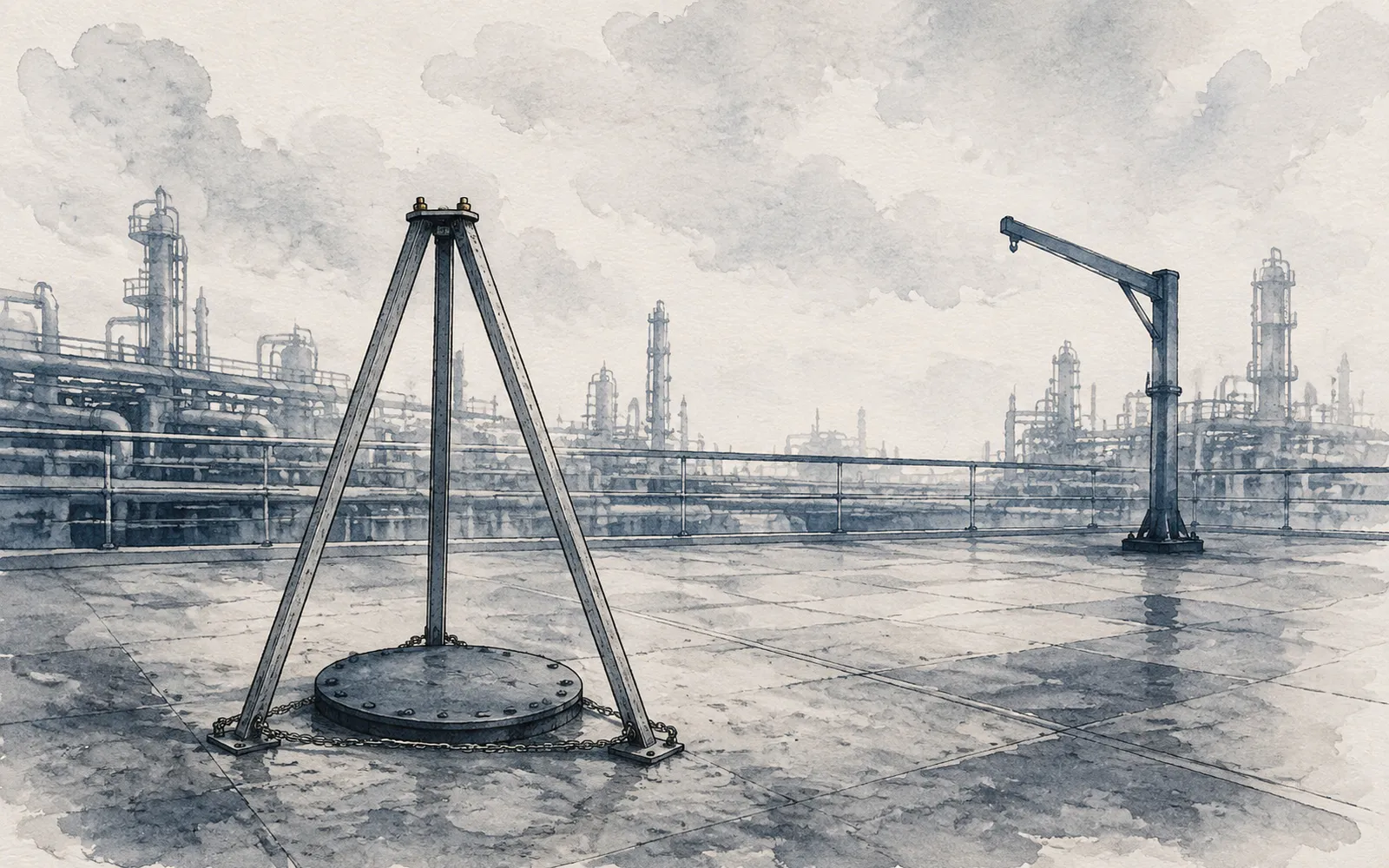
A confined space entry that goes wrong is a retrieval problem, and the hardware has to be standing over the opening before anyone goes in. Two shapes of hardware do that job: a tripod, which straddles the opening on three legs, and a davit arm, which stands to one side on a mast and reaches out over it.
The geometry decides which one you can use. What catches buyers out is the second half: a davit arm is only half a purchase. Arm and mast do nothing until seated in a base, a separate item with its own rating, its own installation, and often its own concrete.
What is the actual difference between a tripod and a davit arm?
A tripod puts an anchor over an opening by standing around it; a davit arm does it by reaching over from beside it. FallTech puts it plainly: tripods “are ideal for vertical entries like manholes,” while davits “handle tight or offset spaces where headroom is limited” and “mount to portable, fixed, or vehicle bases and reach over tanks or railings” (FallTech, confined space safety).
The tripod’s limitation is its feet. It needs three patches of solid, level ground around an opening that is itself more or less vertical and unobstructed. A manway in the side of a vessel, a hatch on a sloped tank top, a pit ringed with pipework — none give a tripod anywhere to stand. FallTech’s 7275 adjusts from 6 to 11 feet (FallTech 7275), and that reach is worthless if the legs cannot be placed. A davit arm moves the legs out of the problem and into the base.
Why does one tripod carry three different capacity numbers?
Fall arrest, personnel riding and material handling are three different loads, held to three different requirements, and manufacturers publish them in three different formats.
3M’s DBI-SALA tripod instructions show it best. One head assembly carries a maximum static strength of 5,000 lbf (22.2 kN); a maximum arresting force of 1,800 lbf (8 kN) if the fall arrest subsystem sits on the eye bolt but 1,500 lbf (6.7 kN) on the mounting bracket; a two-person figure of 420 lb (191 kg) each with “one person remains grounded while the other is raised or lowered”; and material handling limits of 1,000 lb (454 kg) at the eye bolt against 600 lb (272 kg) at the bracket. The manual warns: “Never secure this product to materials and users simultaneously” (3M tripod user instructions).
FallTech labels it differently again — “Rescue Static Strength: 5,000 lb min.”, “Entry/Egress Static Strength: 1,800 lb min.”, “Entry/Egress Capacity: 1 user, 310 lb max.” and “Rescue User Capacity: 2 users, 310 lb max. for each person,” all on one davit system (FallTech 6050328R). Four labels, and not one is called “the capacity.” FallTech publishes no material-handling rating for the 7275 tripod at all.
European systems differ again. Skylotec’s TRIBOC, declared to EN 795:2012/B and CEN/TS 16415:2013, publishes a maximum of two persons, a material load up to 500 kg with chain tensioners, and three further attachment points for material loads up to 200 kg (Skylotec TRIBOC).
The 5,000 lb number is an anchorage strength requirement, not a working capacity — see what a 5,000 lb anchor point actually means.
How do published ratings compare across systems?
They do not compare cleanly, and that is the finding. ISC and CMC publish working load limits and breaking strengths; the US makers publish user capacities and static strengths; Skylotec publishes person counts and kilogram material loads.
| System | Standards cited | Person capacity (published) | Strength / material figure |
|---|---|---|---|
| FallTech 7275 tripod | OSHA 1926.502, 1910.66 | 130 to 310 lb max., 1 user | 5,000 lb min. static strength |
| FallTech 6050328R davit + 3-piece base | OSHA 1926.502, 1910.66; SRL-R to ANSI Z359.14-2014 | Entry/egress 1 user, 310 lb; rescue 2 users, 310 lb each | 5,000 lb min. rescue; 1,800 lb min. entry/egress |
| 3M DBI-SALA tripod | OSHA 1910.140, 1926.502 | 420 lb/person, two-person, one grounded | 1,000 lb at eye bolt; 600 lb at bracket |
| Skylotec TRIBOC tripod | EN 795:2012/B, CEN/TS 16415:2013 | 2 persons; no per-person mass | 500 kg with chain tensioners; 200 kg at each of 3 extra points |
| ISC TP143B tripod | EN 795(B) 1997; NFPA [G] | 2 persons | WLL 360 kg (794 lb); MBS 36 kN (7,936 lbf) |
| CMC Arizona Vortex | NFPA General Use; EN 795:2012/B, CEN/TS 16415:2013 | Not published | MBS 36 kN (8,093 lbf) |
Working load limit, static strength and minimum breaking strength are three different quantities: ISC’s 360 kg WLL (ISC TP143B) and CMC’s 36 kN MBS (CMC Arizona Vortex) are not the same kind of number, and neither is 3M’s 420 lb per person.
The NFPA classifications in that table are their own subject — see NFPA G vs T rating. The SMC TerrAdaptor sits in the same class at 36 kN MBS, certified by UL to NFPA 1983 in symmetric tripod and quadpod configurations (TerrAdaptor); the sell sheet from Harken Industrial, which owns SMC, recommends the quadpod above 9 feet (Harken Industrial). Multipods reconfigure as bipods and monopods, reaching places a fixed tripod cannot.
Is a retrieval winch the same as an SRL with retrieval capability?
No — a winch raises and lowers, and does not arrest a fall. 3M’s Salalift and Salalift II winch instructions publish a rated working load of 350 lb (158 kg), state that “A back-up personal fall arrest system must be attached to the suspended employee,” and warn “Do not use winch for lifting or lowering of more than one person, except for emergency situations.” The same instructions say it “is intended to meet industry standards, including OSHA 1910.146 and ANSI Z117.1” (Salalift winch instructions) — confined space standards, not fall arrest ones.
An SRL-R does both jobs. FallTech describes it as a device that “includes a rescue feature that lets a fallen worker be raised or lowered, making it ideal for confined spaces,” and lists SRL-R as one of three device types under ANSI/ASSP Z359.14-2021, “Safety Requirements for Self-Retracting Devices for Personal Fall Arrest and Rescue Systems,” in force since 1 August 2023 (FallTech on Z359.14-2021). Which class of device you need is a separate decision — see what a leading-edge SRL is.
The rescue side has its own standard: ANSI/ASSE Z359.4-2013, “Safety Requirements for Assisted-Rescue and Self-Rescue Systems, Subsystems and Components,” whose scope covers “winches/hoists” and “self-retracting lanyards with integral rescue capability” for one to two persons (ANSI webstore). A winch can meet that without ever arresting a fall, which is why kits specify one or the other: FallTech’s 7500 pairs the tripod with an SRL-R, the 7505S with a personnel winch. If a quote says only “winch,” ask what is arresting the fall.
Why does a davit arm’s rating depend on its base?
The system is only as strong as its weakest component, and the base is a component. 3M’s offset davit instructions say it twice: “The user capacity of a complete Fall Protection system is limited by its lowest rated maximum component,” and “System rating is that of the lowest rated system component” (3M offset davit instructions).
Skylotec puts the dependency in the rating itself: the JACKPOD DAVIT SET publishes a 280 kg maximum load, qualified as applying “in conjunction with the permanently installed bases for up to two people with 140 kg each” (Skylotec JACKPOD DAVIT SET). Take away the base and the 280 kg does not travel with the arm.
Bases are ordered separately, with their own figures. FallTech’s floor-mount stainless base is rated 620 lb at a minimum 4:1 design factor, with a 6,167 ft-lb mast moment proof load and a 9-inch deep sleeve; it bolts to steel or concrete, takes user-supplied fasteners, and meets OSHA 1926.502 and 1910.66 “when used in a complete system” (FallTech 65060FMS). Fixed sleeves are cast in, cored in, wall- or deck-mounted; portable options run to counterweighted racks, manhole collars and hitch mounts (3M davit base range).
Portable counterweighted bases avoid the concrete but not the floor space: FallTech’s five-piece systems ship with a three-piece base adjusting from 38 to 65 inches wide, carrying an arm adjustable from 12 to 29 inches of offset — beside the opening rather than over it.
What does US federal law require for confined space retrieval?
Under 29 CFR 1910.146(k)(3), which governs permit-required confined spaces in US general industry, “A mechanical device shall be available to retrieve personnel from vertical type permit spaces more than 5 feet (1.52 m) deep.” The same paragraph requires each authorized entrant to use a chest or full body harness “with a retrieval line attached at the center of the entrant’s back near shoulder level, above the entrant’s head, or at another point … small enough for the successful removal of the entrant” (eCFR 1910.146).
The rule says mechanical device, not tripod or davit. Which spaces it applies to is taken up in what makes a confined space permit-required, and retrieval planning in whether you need a rescue plan for working at height. ANSI Z359 covers the fall arrest side. Rules vary by jurisdiction; confirm the ones that apply where you work.
The short version
Buy a tripod if the opening is roughly vertical and unobstructed with ground for three legs around it. Buy a davit arm if you are reaching over an edge, into a side-entry vessel, or into a space where legs cannot be planted — and budget for the base at the same time, because the arm alone carries no rating without one. Work out which number the spec sheet is showing you, because fall arrest, personnel riding and material handling are separate ratings that are rarely presented the same way twice, and confirm whether the lifting device is a retrieval winch or an SRL with retrieval, since only one of them arrests a fall. Where a manufacturer publishes no figure for the job you have in mind, treat the silence as the answer rather than borrowing a number from a product that looks similar.
Quick answers
- Why does a confined space tripod have more than one capacity rating?
- A confined space tripod does several different jobs, and each is rated separately. 3M's DBI-SALA tripod instructions publish a maximum static strength of 5,000 lbf, a maximum arresting force of 1,800 lbf at the eye bolt but 1,500 lbf at the mounting bracket, a two-person user weight of 420 lb each, and material handling limits of 1,000 lb at the eye bolt against 600 lb at the bracket. One head assembly, four different numbers.
- Is a retrieval winch the same as an SRL with retrieval capability?
- No. A retrieval winch raises and lowers a person but does not arrest a fall. 3M's Salalift and Salalift II instructions give a 350 lb rated working load and state that a back-up personal fall arrest system must be attached to the suspended employee. A self-retracting lifeline with retrieval, or SRL-R, arrests a fall first and adds a crank to raise or lower afterward, and is built to ANSI/ASSP Z359.14.
- Does a davit arm need a separate base?
- Yes. A davit arm is a mast and an offset arm with no feet of its own. It drops into a base — a sleeve cast or bolted into concrete or steel, a wall or deck mount, or a portable counterweighted frame. FallTech's floor-mount stainless base is rated 620 lb at a minimum 4:1 design factor with a 6,167 ft-lb mast moment proof load, and needs user-supplied fasteners. A tripod needs no such thing, because its legs are its base.
- Does US federal law require a mechanical retrieval device for confined space entry?
- Under 29 CFR 1910.146(k)(3), which covers permit-required confined spaces in US general industry, a mechanical device shall be available to retrieve personnel from vertical type permit spaces more than 5 feet deep. The same paragraph requires each authorized entrant to use a chest or full body harness with the retrieval line attached at the center of the back near shoulder level, above the head, or another point with a small enough profile for removal. Rules vary by jurisdiction.
- What stops the legs of a confined space tripod from splaying?
- A chain or strap linking the feet, on most systems. 3M's tripod instructions direct users to route the tripod chain through the rings at the bottom of each leg and adjust its length to match the spread. Skylotec's TRIBOC publishes a material load of up to 500 kg only with chain tensioners fitted. Manufacturers do not all agree: ISC states its TP143B tripod can be supplied and used without a foot retention strap.
Brands in this guide
- FallTechCompton, California, since 1992 — one job, done at American construction scale, with a test lab that publishes its own numbers.
- SkylotecNeuwied, Germany, since 1947 — the industrial scale player, and the only brand here that also builds the building's safety system.
- ISC WalesInternational Safety Components — the industrial specialist from North Wales, built for the loads other brands treat as exceptional.
- CMCRooted in rescue since 1978 — the systems professional teams build their capability around.
- SMCFerndale, Washington, since 1967 — rescue hardware made in the USA, UL-certified to NFPA, and owned by the sailing-hardware company your rescue rig already trusts.
- HarkenPewaukee, Wisconsin, since 1968 — two brothers, a plastic ball-bearing block, an Olympic sailing habit, and the employee-owned company that now owns SMC.