What makes a confined space "permit-required"?
Short answer
A confined space is large enough to enter and work in, has limited or restricted means of entry or exit, and isn't designed for continuous occupancy. Under 29 CFR 1910.146 it becomes permit-required if it also has one of four listed characteristics: a hazardous atmosphere, engulfment potential, a trapping configuration, or any other recognized serious safety or health hazard.
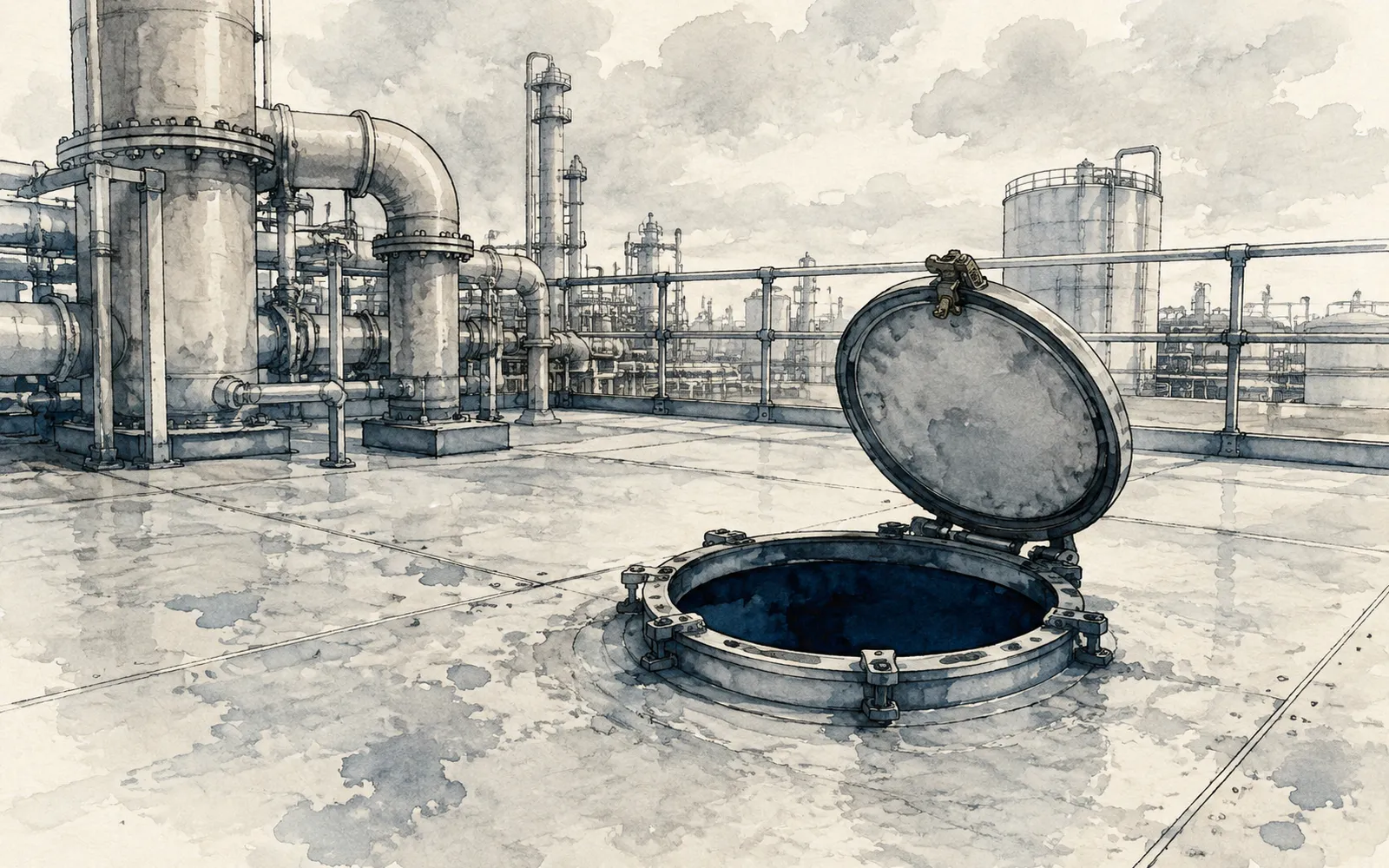
Two definitions are doing the work here, and most confusion comes from collapsing them into one. A space can be confined without being permit-required: the first definition describes a shape, the second what’s in it.
Get them in that order and the standard follows. Get them backwards and you either write permits for crawlspaces or walk into a tank because the hatch was generous.
What counts as a confined space in the first place?
A space has to meet all three tests, not one. 29 CFR 1910.146 puts it this way:
Confined space means a space that: (1) Is large enough and so configured that an employee can bodily enter and perform assigned work; and (2) Has limited or restricted means for entry or exit (for example, tanks, vessels, silos, storage bins, hoppers, vaults, and pits are spaces that may have limited means of entry.); and (3) Is not designed for continuous employee occupancy.
The “and” ending the first two clauses is load-bearing. A duct you can reach into but not work in fails the first test. A mechanical room with a standard door fails the second. And a space isn’t disqualified because somebody spends a shift in it — the test is whether it was designed for continuous occupancy.
Nothing in that definition mentions air. That’s the second definition’s job.
What turns a confined space into a permit space?
One or more of four listed characteristics — the list is closed, so it’s worth quoting in full.
Permit-required confined space (permit space) means a confined space that has one or more of the following characteristics: (1) Contains or has a potential to contain a hazardous atmosphere; (2) Contains a material that has the potential for engulfing an entrant; (3) Has an internal configuration such that an entrant could be trapped or asphyxiated by inwardly converging walls or by a floor which slopes downward and tapers to a smaller cross-section; or (4) Contains any other recognized serious safety or health hazard.
Item (1) says “or has a potential to contain,” a wider net than “contains” — a clean, empty, ventilated tank that could go bad is still a permit space. Item (4) is the catch-all: mechanical or electrical energy, heat, moving parts. A permit hazard needn’t be atmospheric.
The inverse is defined too. A non-permit confined space is “a confined space that does not contain or, with respect to atmospheric hazards, have the potential to contain any hazard capable of causing death or serious physical harm.”
What does the standard count as a hazardous atmosphere?
Specific published thresholds, not a judgment call. The definition of hazardous atmosphere in 1910.146 lists, among other causes, “Flammable gas, vapor, or mist in excess of 10 percent of its lower flammable limit (LFL)”; “Atmospheric oxygen concentration below 19.5 percent or above 23.5 percent”; any substance above its published permissible exposure limit; and “Any other atmospheric condition that is immediately dangerous to life or health.”
Both ends of the oxygen range count — enriched air is a listed hazard for the same reason deficient air is. Gas detection is the instrument category this definition drives hardest, and no brand on our roster makes detectors.
Why does construction get a different rule?
Because 1910.146 explicitly excludes it. The scope paragraph says the section “does not apply to agriculture, to construction, or to shipyard employment (parts 1928, 1926, and 1915 of this chapter, respectively).”
Construction falls under 29 CFR 1926 Subpart AA, which OSHA says took effect on August 3, 2015. It carries the same four permit-triggering characteristics, but the two aren’t interchangeable — even the confined-space test is worded differently.
| 1910.146 (general industry) | 1926 Subpart AA (construction) | |
|---|---|---|
| First test | “can bodily enter and perform assigned work” | “can bodily enter it” |
| Second test | “limited or restricted means for entry or exit” | “limited or restricted means for entry and exit” |
| Who identifies spaces | Employer evaluates the workplace | Competent person identifies them |
| Continuous atmospheric monitoring | Not required | Required whenever possible |
| Engulfment warning | — | “Early-warning system” is a defined term |
| Multi-employer roles | Not defined here | Host employer, controlling contractor, entry employer |
| Permit when conditions change | Cancel | May be suspended |
The lower rows are differences OSHA itself lists; the top two come from the definition sections.
Who does the regulation say has to be there?
Three named roles, defined in the standard rather than left to custom. An attendant is “an individual stationed outside one or more permit spaces who monitors the authorized entrants and who performs all attendant’s duties assigned in the employer’s permit space program.” An authorized entrant is “an employee who is authorized by the employer to enter a permit space.” An entry supervisor is “the person (such as the employer, foreman, or crew chief) responsible for determining if acceptable entry conditions are present … for authorizing entry and overseeing entry operations, and for terminating entry.”
Each has its own paragraph of duties — (h) authorized entrants, (i) attendants, (j) entry supervisors — and (d)(6) requires “at least one attendant outside the permit space into which entry is authorized for the duration of entry operations.”
The construction rule keeps all three and adds the competent person plus the host employer / controlling contractor / entry employer chain — an entry employer being “any employer who decides that an employee it directs will enter a permit space.”
Can a space be entered without a full permit?
Yes, under two provisions, each with conditions the regulation states explicitly. Neither is a shortcut you can reason your way into.
The alternate procedures at 1910.146(c)(5)(i) let an employer skip paragraphs (d) through (f) and (h) through (k) provided that: the only hazard posed by the space is “an actual or potential hazardous atmosphere”; “continuous forced air ventilation alone is sufficient to maintain that permit space safe for entry”; the employer develops monitoring and inspection data supporting both; any initial entry needed to obtain that data is performed in compliance with paragraphs (d) through (k); and the determinations and data are documented and made available to each employee who enters, or their authorized representative.
Reclassification at 1910.146(c)(7) applies where the space “poses no actual or potential atmospheric hazards and if all hazards within the space are eliminated without entry into the space.” It may then be reclassified as a non-permit confined space “for as long as the non-atmospheric hazards remain eliminated.” If entry is needed to eliminate them, that entry runs under the full requirements first. Either way the employer certifies the basis, with the date, the location and a signature; if hazards return, everyone exits and the space is re-evaluated.
Both rest on a demonstration the employer can produce, not an opinion formed at the hatch.
What equipment does the rule actually drive?
Three categories, each named in the standard’s own text.
Retrieval systems. Under 1910.146(k)(3), “retrieval systems or methods shall be used whenever an authorized entrant enters a permit space,” unless the equipment “would increase the overall risk of entry or would not contribute to the rescue of the entrant.” The other end attaches to “a mechanical device or fixed point outside the permit space,” and one “shall be available to retrieve personnel from vertical type permit spaces more than 5 feet (1.52 m) deep.” That 5-foot line is what puts a tripod or davit in the kit; which of the two is covered in tripod vs davit. It needs an anchorage — see 5,000 lb anchor points.
ISC publishes a tripod system and a rescue winch, and Ronin a tripod mount that puts a power ascender on the frame. Thin coverage for the category.
A harness with the right attachment. The same paragraph specifies that each authorized entrant “shall use a chest or full body harness, with a retrieval line attached at the center of the entrant’s back near shoulder level, above the entrant’s head, or at another point … small enough for the successful removal of the entrant.” Wristlets are allowed only where a harness is “infeasible or creates a greater hazard.” That’s why confined-space harnesses carry shoulder attachment points a general fall-arrest harness may not have. FallTech and Skylotec build to that pattern; when to retire one is answered in harness retirement.
Lighting rated for the atmosphere. 1910.146(d)(4)(v) requires “Lighting equipment needed to enable employees to see well enough to work safely and to exit the space quickly in an emergency.” It names no certification; where the atmosphere may be flammable, that’s what intrinsically safe ratings are for. Princeton Tec publishes an ETL rating of “Zone 0, Class I Division 1 Intrinsically Safe” on the Vizz II, and Streamlight “Class I & II, Division 1” on the Survivor Pivot. Those markings are what to read.
Rescue planning is separate — see rescue plans.
Does this apply outside the United States?
No — 1910.146 and 1926 Subpart AA are US federal regulations and nothing more. OSHA-approved State Plans are run by individual states and territories and must be “at least as effective as OSHA” — a floor, not a copy — so the text that applies where you work may not be the federal one. Outside the United States, OSHA does not apply.
Rules vary by jurisdiction. Read the one that covers your workplace.
The short version
A confined space is a shape: big enough to enter and work in, hard to get in or out of, not designed for continuous occupancy — all three, not any one. It becomes permit-required when it also has a hazardous atmosphere, engulfment potential, a trapping internal configuration, or any other recognized serious hazard. Construction is carved out of 1910.146 and runs under 1926 Subpart AA, with its own multi-employer roles. The equipment the rule names is narrow — a retrieval system, a harness someone can be pulled out by, lighting rated for the atmosphere — and all of it is US federal law, not the law everywhere.
Quick answers
- Does every confined space require an entry permit?
- No. Under 29 CFR 1910.146 a confined space only becomes a permit-required confined space if it has one or more of four listed characteristics: it contains or could contain a hazardous atmosphere, contains a material that could engulf an entrant, has an internal configuration that could trap or asphyxiate someone, or contains any other recognized serious safety or health hazard. Without one of those, it is a non-permit confined space.
- Is a manhole automatically a permit-required confined space?
- Not automatically. OSHA's definition turns on hazards, not on the name of the structure. 29 CFR 1910.146 lists pits and vaults as examples of spaces that may have limited means of entry, which speaks to the confined-space test, not the permit test. A space becomes permit-required only when it has a hazardous atmosphere, engulfment potential, a trapping configuration, or another recognized serious safety or health hazard.
- Does OSHA's general industry confined space standard apply to construction work?
- No. 29 CFR 1910.146 states that it "does not apply to agriculture, to construction, or to shipyard employment (parts 1928, 1926, and 1915 of this chapter, respectively)." Construction work is covered instead by 29 CFR 1926 Subpart AA, Confined Spaces in Construction, which OSHA says took effect on August 3, 2015 and carries requirements the general industry rule does not.
- What oxygen concentration counts as a hazardous atmosphere under OSHA?
- Under the definition of hazardous atmosphere in 29 CFR 1910.146, an "atmospheric oxygen concentration below 19.5 percent or above 23.5 percent" qualifies. Both ends of that range count — an oxygen-enriched atmosphere is a listed hazard just as an oxygen-deficient one is. The same definition separately covers flammable gas above 10 percent of its lower flammable limit and any condition immediately dangerous to life or health.
- When can a permit space be reclassified as a non-permit confined space?
- 29 CFR 1910.146(c)(7) allows it where the space "poses no actual or potential atmospheric hazards and if all hazards within the space are eliminated without entry into the space," for as long as those hazards stay eliminated. The employer must document the basis through a certification carrying the date, the location of the space, and the signature of the person making the determination.
Brands in this guide
- SkylotecNeuwied, Germany, since 1947 — the industrial scale player, and the only brand here that also builds the building's safety system.
- FallTechCompton, California, since 1992 — one job, done at American construction scale, with a test lab that publishes its own numbers.
- ISC WalesInternational Safety Components — the industrial specialist from North Wales, built for the loads other brands treat as exceptional.
- RoninPlacentia, California — power ascenders designed by people who used to build rescue hoists for helicopters.
- Princeton TecPennsauken, New Jersey — the one lighting brand on this site that still makes the whole light in America, and says so without a qualifier.
- StreamlightEagleville, Pennsylvania, since 1973 — the light that carries the certification when SureFire money isn't on the table.