Should a headlamp use rechargeable or disposable batteries?
Short answer
Rechargeable for regular use — cheaper over time, and usually brighter, because a lithium-ion cell delivers higher current than three AAAs. For deep cold and for anything stored unused, primary lithium AA or AAA cells are the better answer: they are rated to minus 40 degrees Celsius where alkaline stops at about minus 18, they weigh a third less, and they will not corrode the lamp. Alkaline's real problem is not runtime, it is leakage.
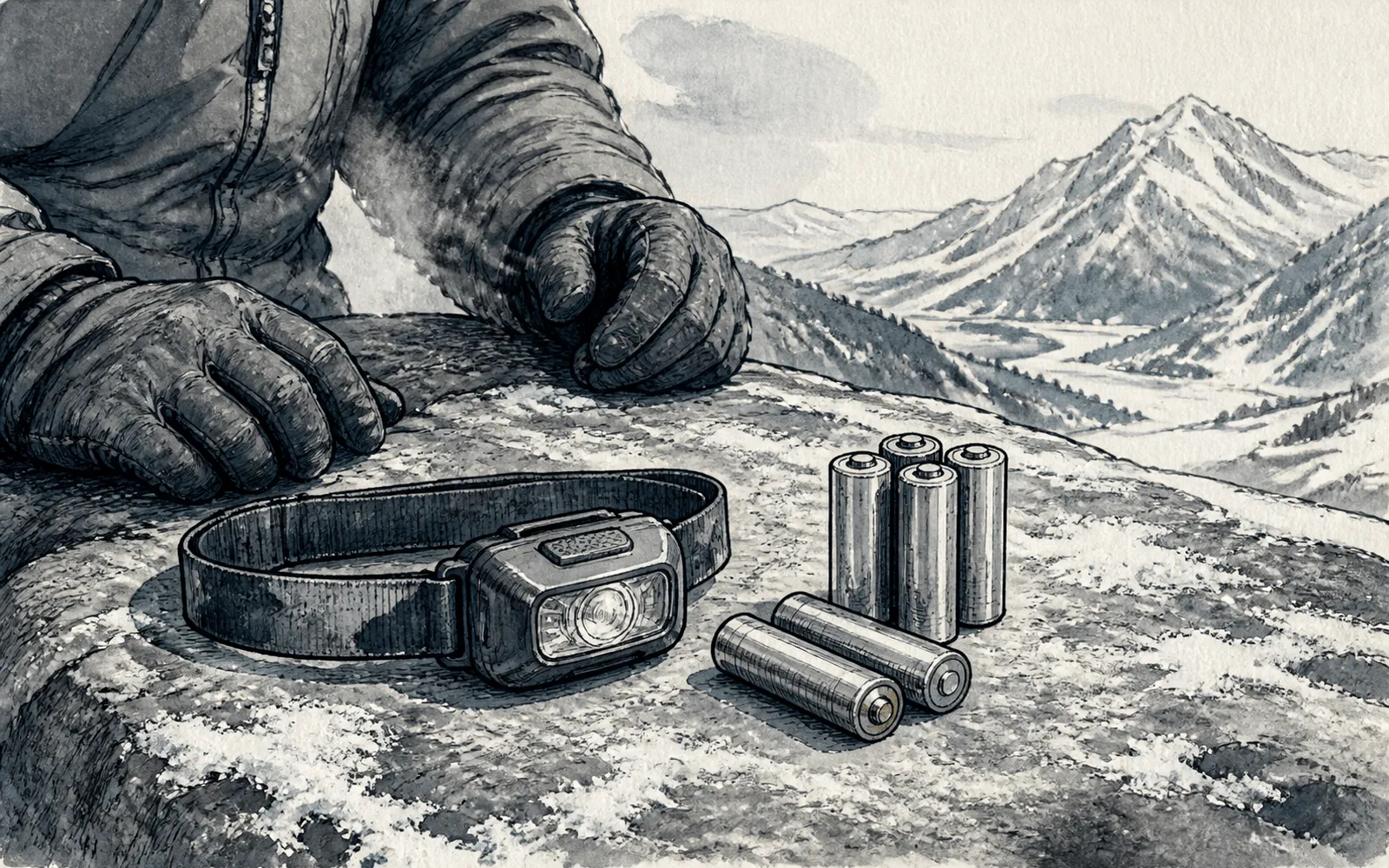
The rechargeable-versus-disposable argument is usually had as a cost and convenience question. It is more interesting than that, because the battery changes what the light does — its brightness, the shape of its runtime curve, and whether it works at all when it is properly cold.
Should a headlamp use rechargeable or disposable batteries?
Rechargeable for everyday use. Cheaper over time, usually brighter, and no cells to buy.
Primary lithium for deep cold and for anything that sits unused. Rated far lower in temperature, a third lighter, and it will not corrode the lamp it is sitting in.
Note that “disposable” hides two very different products. Alkaline and primary lithium are not the same purchase, and almost all of the interesting differences below are between those two, not between disposable and rechargeable.
Does the battery change how bright the lamp is?
Yes, substantially — on the same lamp.
| Lamp | On rechargeable | On disposable |
|---|---|---|
| Petzl ACTIK CORE | 625 lm (CORE Li-ion) | 450 lm (3× AAA) |
| Streamlight Sidewinder Compact II | — | 6 h high on CR123A or AA lithium vs 2 h on AA alkaline |
| SureFire EDC1-DFT | 650 lm / 45 min (18350) | 350 lm / 1 h (CR123A) |
A 28 percent brightness difference from the power source alone, and a threefold runtime difference on chemistry alone. Lithium-ion cells deliver higher current than three AAAs in series can, which is why the flagship output figure is usually quoted on the rechargeable.
The SureFire row shows the trade running the other way: higher output and shorter runtime on the rechargeable. Direction depends on the model, so read the spec table for both power sources rather than assuming.
There is also a difference in the shape of the discharge. Petzl states that with the CORE rechargeable, brightness generally stays constant over the rated burn time, while on AAA cells brightness gradually decreases as they drain. Regulated output means bright then a cliff; unregulated means a long dim tail. Which you want depends on whether you would rather have certainty or warning.
What actually happens in the cold?
This is where the common advice is wrong, and where the manufacturers are clearer than the internet.
Alkaline is the weak option. Energizer’s alkaline AA datasheet gives an operating range of −18 °C to 55 °C; Duracell says −20 °C to 54 °C. Duracell’s technical bulletin puts a number on the degradation: for most cells, up to 75 percent of the rated room-temperature capacity can be delivered at 0 °C — so a quarter is gone at freezing, before it gets properly cold. Energizer explains the mechanism nicely: no capacity is actually lost to cold, it is simply harder to access as the electrochemical reactions slow.
Primary lithium is the cold answer. Energizer’s Ultimate Lithium AA datasheet gives −40 °C to 60 °C — twenty-two degrees more headroom at the bottom — and the cell weighs 15 g against 23 g for the alkaline, a third lighter. Princeton Tec says it plainly in its own manuals: lithium batteries hold a charge better in extreme cold and are lighter than alkaline or rechargeable. Streamlight publishes an operating range of −40 °F to 140 °F for a lithium-cell light.
Rechargeable is not immune, and Petzl says so. Its Hybrid Concept page states that standard batteries, including the CORE rechargeable, are sensitive to cold below 0 °C, and that between 0 and −20 °C burn time can be reduced by up to 50 percent.
Worth flagging an inconsistency rather than papering over it: a separate Petzl article says lithium-ion is better at holding charge in the cold than disposables. Both pages are live. Neither distinguishes primary lithium from alkaline — which is the distinction that actually decides the question, and the one Princeton Tec, Streamlight and the cell datasheets all make.
Mitigation is the same across every brand: keep the battery warm. Petzl suggests a pocket. Silva sells an extension cable specifically so the pack can live inside a jacket or running vest. BioLite builds a pass-through mode into the 800 Pro so external power can bypass the internal cell in extreme cold. Three different companies, one answer.
One rule that catches people out in winter: do not charge a lithium-ion cell at freezing temperatures. Sub-freezing charging can plate metallic lithium onto the anode, causing permanent degradation in performance and safety. Warm the lamp first.
Why is alkaline’s real problem leakage, not runtime?
Because a flat battery is an inconvenience and a leaked one is a dead headlamp.
Streamlight states it outright: battery leakage is the number one cause of failure in alkaline-powered flashlights. Not LED failure, not switch failure, not water. Leakage.
Duracell’s own guidance is a list of the ways it happens:
- Don’t leave batteries in a device you suspect will not be used for several months.
- Remove depleted cells promptly — some devices keep drawing from exhausted batteries, which can cause them to leak.
- Don’t mix old and new cells, brands, or types.
- Don’t store in warm places — heat reduces performance and can lead to leakage.
There is a specific failure mode for headlamps in that list. In a three- or four-cell series string, an exhausted cell can be driven into voltage reversal by the others, with progressive risk of leakage or rupture. Which is exactly the configuration of most AAA headlamps.
Princeton Tec and Energizer both give the same instruction for storage: remove the batteries. It takes ten seconds and it is the difference between a lamp that works next season and one with green crust in the contacts.
So which should you buy?
| Use | Buy |
|---|---|
| Daily, urban, predictable | Rechargeable |
| Winter, alpine, arctic | Primary lithium |
| Emergency kit, vehicle, stored years | Primary lithium, or rechargeable stored at partial charge and topped up |
| Multi-day with no power | Hybrid lamp — rechargeable primary, spare lithium cells |
| Left in a drawer | Anything except alkaline left inside the lamp |
Two storage notes. Petzl advises not to store rechargeable cells fully discharged and to recharge stored batteries periodically — its guidance ranges from every three to every six months depending on which page you read. And primary lithium’s 25-year stated shelf life is what makes it the right choice for a kit you hope never to open.
Why hybrid lamps are the quiet right answer
A lamp that takes either is not about convenience. It is about the failure case.
Petzl’s Hybrid Concept runs a CORE rechargeable or three AAAs with no adapter. Nitecore’s UT27 takes a rechargeable pack or three AAAs. Black Diamond offers dual-fuel models. BioLite’s 800 Pro is rechargeable-only, which is a legitimate design choice — it just means the pass-through port is your backup rather than a gas-station AAA.
A dead rechargeable ten miles in is a problem. A dead rechargeable that also accepts AAAs is an errand. For a light you might need rather than one you plan to use, that is worth more than any lumen figure — including the ones we look at in how many lumens you actually need.
Quick answers
- Which battery type is best for a headlamp in cold weather?
- Primary lithium cells, such as Energizer's Ultimate Lithium AA. Their datasheet gives an operating range of minus 40 to 60 degrees Celsius, against minus 18 to 55 for the equivalent alkaline. Princeton Tec states in its own manuals that lithium batteries hold a charge better in extreme cold and weigh less than alkaline or rechargeable cells. Petzl notes that rechargeable cells are also cold-sensitive, with burn time reduced by up to 50 percent between 0 and minus 20 degrees Celsius.
- Do rechargeable headlamps produce more light than AAA ones?
- Often yes, on the same lamp. The Petzl ACTIK CORE is rated 625 lumens on its lithium-ion CORE battery and 450 lumens on three AAA cells — a 28 percent difference from the power source alone. Streamlight's Sidewinder Compact II gives 6 hours on high with CR123A or AA lithium against 2 hours with AA alkaline. Battery chemistry changes the published performance of the identical light.
- Why do alkaline batteries damage flashlights?
- They leak. Streamlight states that battery leakage is the leading cause of failure in alkaline-powered flashlights. Duracell advises removing batteries from a device that will not be used for several months, removing depleted cells promptly because some devices keep drawing power from them, and never mixing old and new cells or different brands, as any of these can cause leakage. In a multi-cell headlamp, an exhausted cell in series can be driven into voltage reversal by the others.
- Can you charge a lithium-ion headlamp in freezing conditions?
- It should be avoided. Lithium-ion cells are normally specified for charging between about 0 and 45 degrees Celsius, with no charging permitted at freezing temperatures, because metallic lithium can plate onto the anode during a sub-freezing charge and cause permanent degradation in performance and safety. Warm the lamp before charging it in winter conditions.
- Is a hybrid headlamp that takes both worth it?
- For most people, yes. Petzl's Hybrid Concept lamps run either a rechargeable core or three AAA alkaline, lithium or NiMH cells with no adapter; Nitecore's UT27 takes a rechargeable pack or three AAAs; Black Diamond offers dual-fuel models. The value is not everyday convenience but the failure case — a dead rechargeable at the trailhead is solved by a convenience-store purchase rather than ending the trip.
Brands in this guide
- PetzlFifty years of French vertical-safety engineering, and the spine of most rope access kits — including ours.
- Princeton TecPennsauken, New Jersey — the one lighting brand on this site that still makes the whole light in America, and says so without a qualifier.
- StreamlightEagleville, Pennsylvania, since 1973 — the light that carries the certification when SureFire money isn't on the table.
- Black DiamondClimbing equipment and mountain lighting, with practical choices for the crag, trail and camp.
- NitecoreGuangzhou since 2007 — the brand that got into your kit through the battery charger, not the flashlight.
- BioLiteBrooklyn — a camp stove that charges your phone off its own fire, and a business built so that campers in New York pay for cookstoves in Kenya.
- SureFireFountain Valley, 1979 — the company that invented the weapon light, prices it like it, and makes suppressors down the hall.