What goes into a Battle Born camper power system?
Short answer
A camper power system needs storage, suitable charging, distribution and protection, plus an inverter when AC loads require one. Battle Born sells batteries and supporting components, including a 2000W inverter/charger. Select them as a compatible system: a matching brand name alone does not establish electrical compatibility or installation requirements.
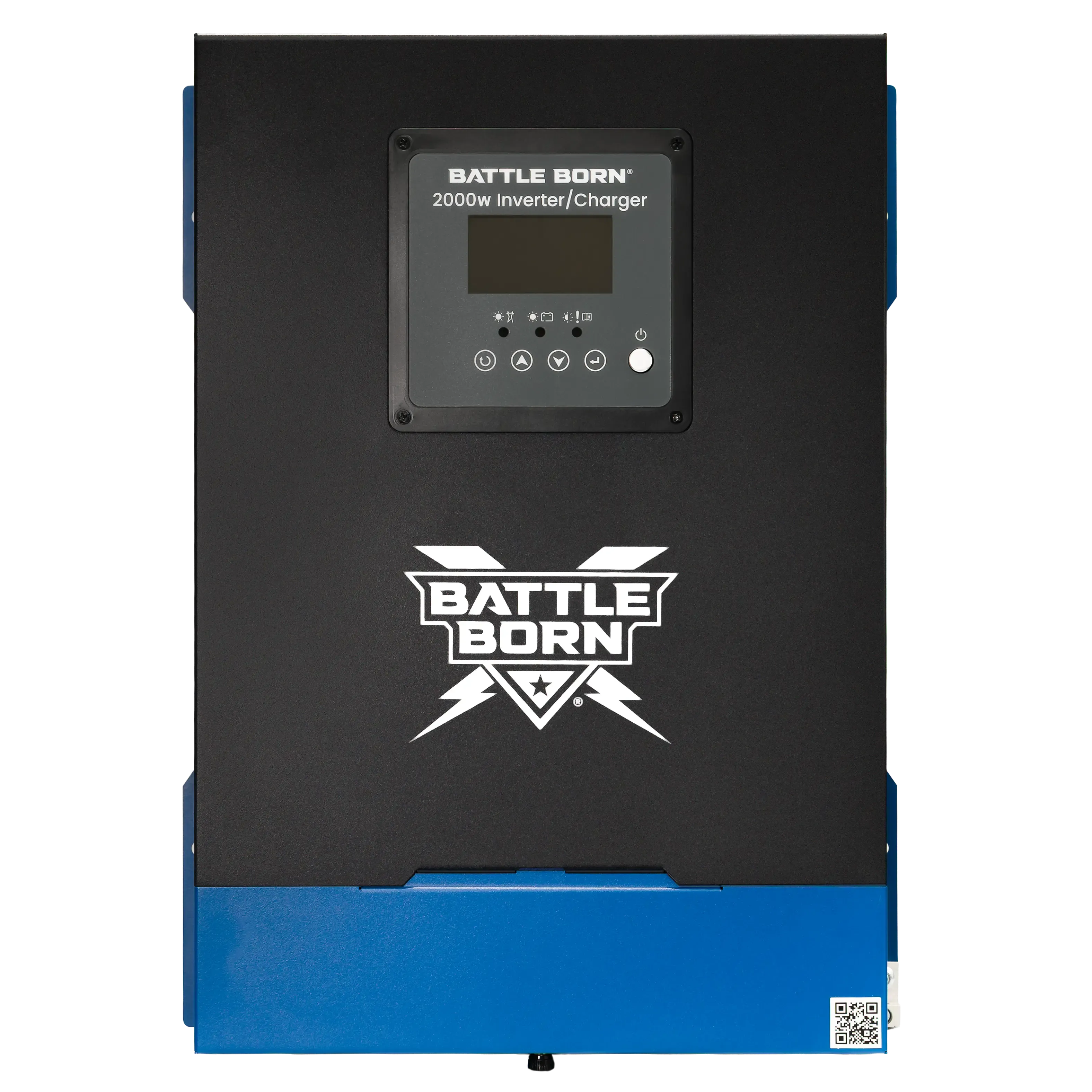
A battery answers where energy is stored. It does not, on its own, answer how the camper receives shore power, charges while driving or powers an AC appliance. Those are separate jobs in the system design.
What does each part do?
Each part does one of five jobs: storing energy, charging, converting to AC, distributing and protecting circuits, or monitoring. No single component covers all five.
| Part of the system | Job to resolve before buying |
|---|---|
| Battery bank | Store enough energy at the required system voltage |
| Charging equipment | Match each source, such as shore power, solar or the vehicle, to the battery’s charging requirements |
| Inverter | Supply suitable AC power for loads that need it |
| Distribution and protection | Route and protect each circuit as specified for the installation |
| Monitoring | Make available information useful for managing consumption and charging |
This is a map of component roles, not a wiring diagram. Cable sizing, protective devices, grounding, disconnects and mounting require the manuals and a design appropriate to the actual camper.
Where does the Battle Born 2000W inverter/charger fit?
The 2000W inverter/charger combines AC conversion with battery charging and a transfer switch. Battle Born describes pure sine wave output and rates the product at 2000W, with a three-year warranty. Those specifications belong to this component; they are not the battery’s capacity or warranty.
| Specification | What Battle Born lists | Where |
|---|---|---|
| Continuous output | 2000W, “derated above 104ºF (40°C)” | Manual |
| Surge | “2X surge capability”; 4000 W for 5 seconds | Product page; manual |
| Waveform | Pure sine wave | Product page |
| Efficiency | 91% peak; >86% at full load | Manual |
| Idle (no-load) draw | Not published | — |
| Charger output | “User selectable: 5 to 100Ah” (unit as printed) | Manual |
| LiFePO4 charge profile | 14.4 V absorption, 13.6 V float | Manual |
| AC transfer time | 20 ms; 10 ms in UPS mode | Manual |
| Minimum Battle Born battery bank | 200Ah | Manual only |
| Weight (inverter/charger) | 18.9 lb | Manual |
| Certifications | UL 458, UL 458 Marine Supplement, CSA C22.2 No. 107.1 | Product page |
| Warranty | 3 years | Product page |
These are Battle Born’s listings from the product page and the BBI2000/BBIC2000 manual, not AllEquipped measurements. The 200Ah minimum appears only in the manual, which warns that a smaller bank “will result in damage to batteries not covered under the manufacturer’s warranty.”
The combination can simplify the component list when both functions are needed. It does not tell you whether the intended battery bank can support the connected loads. An appliance with a modest running draw can also have a startup demand that needs separate checking.
Which loads belong in the plan?
Every load belongs in the plan, on two lists: devices supplied directly from the camper’s DC system and devices that need AC power. Record which may run together. Then include how often they operate, because maximum simultaneous demand and total daily energy are different questions.
For example, a short period of cooking and an overnight refrigerator load can demand very different things from the inverter and battery. Use equipment specifications or measurements rather than estimating from outlet shape.
What should an installer receive?
Bring the exact battery and inverter model numbers, a load list, the vehicle charging details, available installation space and your expected shore-power or solar use. Ask for a complete compatible design and documentation of the installed settings. Do not choose protection components from a generic internet diagram.
Start the battery shortlist with our overland battery guide and use the Battle Born overview to compare the photographed configurations. A useful system is one that supports the trip and can be understood and serviced afterward.
The short version
A Battle Born camper power system is a set of separate jobs — storage, charging, AC conversion, distribution and protection, and monitoring — and a matching brand name settles none of them on its own. The 2000W inverter/charger covers AC conversion, charging and the transfer switch, with a three-year warranty that is separate from the batteries’ terms. Its manual asks for at least 200Ah of Battle Born batteries behind it, lists a lithium profile inside the battery manual’s own voltage ranges, and publishes no idle draw. List the DC and AC loads separately, note what runs together, and give an installer the exact model numbers, the load list and the charging sources, so the design is checked as one system rather than copied from a diagram.
Product information checked September 23, 2026, and rechecked October 3, 2026. This is a manufacturer-based selection guide, not an AllEquipped hands-on test. Official photograph used with permission.
Quick answers
- Does an inverter/charger replace the battery?
- No. An inverter/charger converts power and provides charging functions; energy storage is supplied by the connected battery bank.
- Does the Battle Born 2000W inverter/charger have the same warranty as its batteries?
- The current Battle Born 2000W inverter/charger page specifies a three-year warranty. Check the separate terms for each battery and component.
- What size battery bank does Battle Born require for its 2000W inverter/charger?
- At least 200Ah when the bank is built from Battle Born batteries. The Battle Born BBI2000/BBIC2000 manual states that "a minimum battery bank of 200Ah or more is Required" and that "Failure to adhere to this minimum bank size will result in damage to batteries not covered under the manufacturer's warranty." The 2000W inverter/charger product page does not mention the minimum. Battle Born rates its BB10012 at 100Ah, so by our arithmetic the requirement means at least two of those batteries.
- What lithium charge voltages does the Battle Born 2000W inverter/charger use?
- The Battle Born BBI2000/BBIC2000 manual lists a LiFePO4 profile of 14.4 V absorption and 13.6 V float, and charger output as "User selectable: 5 to 100Ah", printing the unit as Ah rather than amps. Battle Born's BB10012 battery manual gives "14.2V to 14.6V" for bulk/absorption and "13.4V to 13.8V" for float, so the inverter/charger's profile sits inside the battery's published ranges. The manual says charging features "apply only to the Inverter/Charger model", not the inverter-only BBI2000.
- Does Battle Born publish an idle power draw for its 2000W inverter/charger?
- No. The Battle Born 2000W inverter/charger product page lists 2000W with "2X surge capability", and the BBI2000/BBIC2000 manual adds a 4000 W surge for five seconds, 91% peak efficiency and more than 86% at full load. Neither the page nor the manual gives a no-load, standby or idle current figure. In a camper that leaves the inverter switched on overnight, that consumption has to be measured rather than read from Battle Born's published specifications.
Brands in this guide
Sources
- Battle Born Batteries — 2000W Inverter / Charger (BBIC2000) product page
- Battle Born Batteries — 100Ah 12V LiFePO4 Deep Cycle Battery (BB10012) product page
- Battle Born Batteries — BBI2000/BBIC2000 2000W inverter and inverter/charger manual, revision 010 (PDF)
- Battle Born Batteries — BB10012/BB10012H 100Ah 12V battery manual, revision 038 (PDF)