What is a leading-edge SRL? The 0.005 inch answer, and FallTech's EdgeCore
A Class 2 SRL is qualified by being dropped over a steel edge with a radius of five thousandths of an inch. That single test explains the lifeline, the anchor rules, and why foot-level work needs roughly double the clearance.
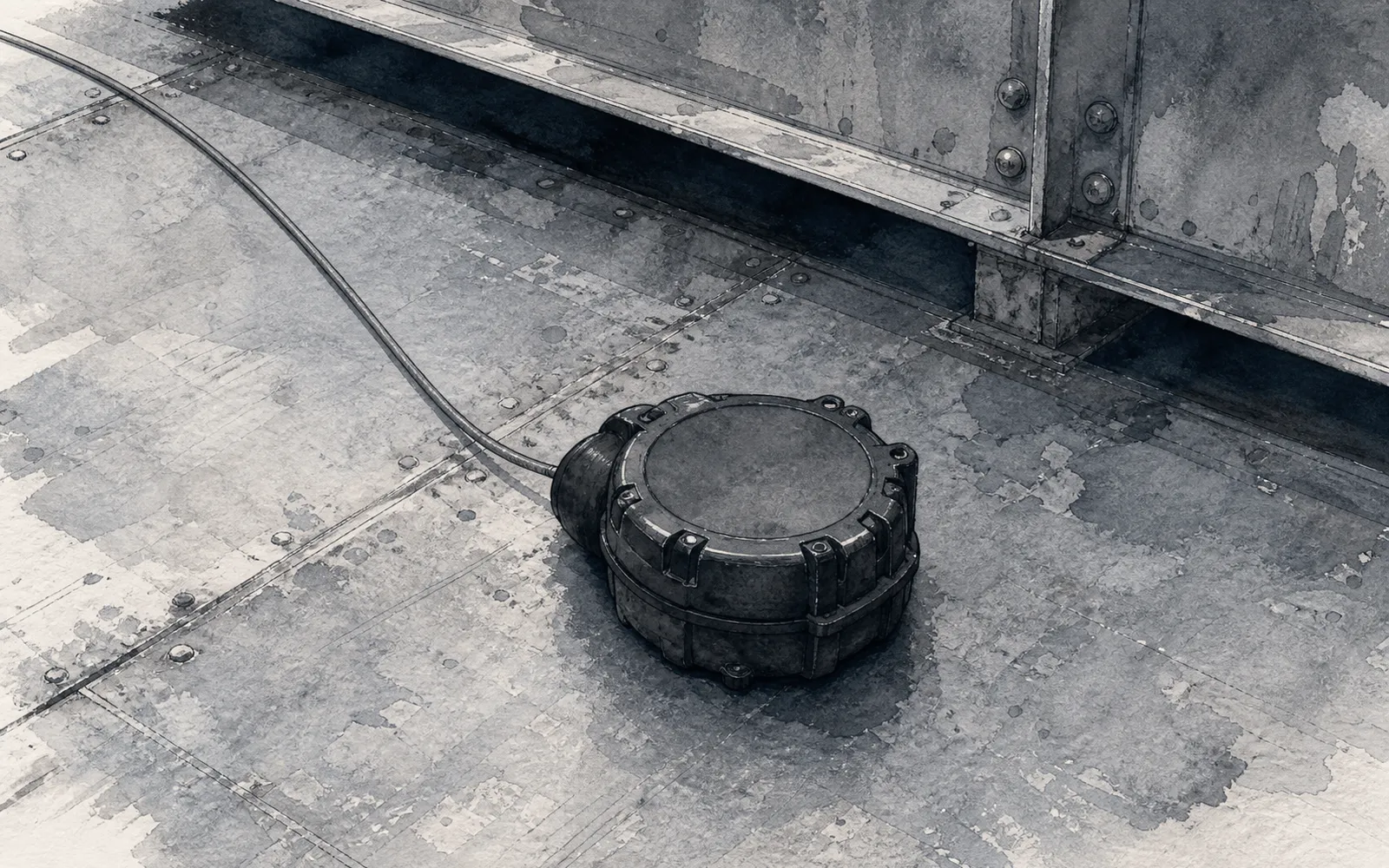
Anchor an SRL over your head and the physics are gentle. Anchor it at your feet, run the lifeline across the edge of the deck you’re standing on, and every assumption in the product changes at once.
That second case has its own class of device. Here’s what qualifies one.
For the short answer — what a leading-edge SRL is and when you need one — see the guide: what is a leading-edge SRL, and when do you need one? This piece is the test behind it.
What makes an SRL “leading edge”?
Passing a drop test in which the lifeline is loaded across a steel edge with a radius of 0.005 inches — about a tenth of a millimeter. That’s the whole idea. Not a marketing tier, not a build quality claim: a specific test with a specific edge.
The figure is consistent across manufacturers. MSA’s leading-edge infographic states devices are “TESTED ON A STEEL EDGE, WITH A RADIUS OF 0.005” (0.127 mm)“; MSA’s safety blog repeats it as “a steel bar with a radius of .005 inches or less”; FallTech describes qualifying its own devices “using a sharpened steel edge with a radius of .005 or sharper.”
One nuance that gets lost: the test edge is sharp but deburred. FallTech’s own manual for its cable Class 2 units specifies testing “for falls over a steel edge without burrs, as found on steel shapes and metal sheeting.” A rolled steel edge is the design case. A torn, burred, freshly cut edge is not, and no device is qualified for it.
What’s the difference between Class 1 and Class 2?
Class 1 is for overhead anchorages and a maximum 2 ft free fall. Class 2 is for anchorages that may not be overhead, and a maximum 6 ft free fall over an edge.
That’s the standard’s own framing, from ANSI/ASSP Z359.14-2021 §1.4.1 and §1.4.2. Manufacturers usually explain it by D-ring position — Class 1 anchored at or above the dorsal D-ring, Class 2 above or below — which is a fair paraphrase of the same idea, but the text is written around overhead-ness and free fall distance.
The rest of the 2021 revision, which took effect 1 August 2023 and replaced the old Type A / Type B split:
| Z359.14-2021 | |
|---|---|
| Capacity range | 130–310 lb (59–141 kg) |
| Test mass | 310 lb, up from 282 lb |
| Max deceleration distance | 42 in., both classes |
| Max average arresting force | 1,350 lb ambient; 1,575 lb conditioned |
| Max peak arresting force | 1,800 lb |
| Line outside housing when retracted | 48 in. max, SRL-P and Class 2 |
Figures from 3M’s technical summary of the revision, which is the most complete public accounting of the changes. Note the average arresting force has two values — 1,350 lb is the ambient-condition limit, and conditioned testing permits 1,575 lb. A flat “1,350 lb” is the number most often quoted and it’s incomplete.
The 1,800 lb peak matches OSHA 1926.502(d)(16)(ii), which caps arresting force on an employee in a body harness at the same figure. The 42 in. deceleration limit also happens to match OSHA’s 3.5 ft — but OSHA is regulating the rigged system and Z359.14 is qualifying the device, so the convergence is a coincidence worth not over-reading.
What is EdgeCore, and is it really 40% lighter?
It’s a Kevlar-cored lifeline in a composite jacket, and 40% is the published figure — but read what it’s compared against.
FallTech’s product pages state the “EdgeCore™ lifeline is made from Kevlar® cables and a UV-resistant composite jacket, weighing 40% less than 3/16” galvanized cable,“ with a listed minimum static strength of 5,000 lb. The EdgeCore hub page makes the same 40% claim about the whole device rather than the lifeline, and separately says the breaking strength is “more than three times that of conventional 3/16” galvanized wire rope.“
Two cautions. The 40% is a comparison to one specific alternative — 3/16“ galvanized cable — not to leading-edge SRLs generally. And the 5,000 lb figure is a minimum rating, not a breaking strength, so it doesn’t sit in the same sentence as the “>3×” claim without confusion. FallTech doesn’t publish an absolute lifeline weight, and the weights on the product pages are labeled package weights, which is why the 6 ft twin-leg is listed heavier than the 8 ft twin-leg. Don’t build a comparison out of those.
Capacity is 130–420 lb per OSHA, 130–310 lb per ANSI. FallTech also states it tested the 8 ft unit over abrasive concrete edges — worth knowing, but that’s a FallTech test, not an ANSI requirement.
What does SpeedLink do?
It lets you replace one leg of a twin-leg unit in the field instead of retiring the pair. FallTech’s wording: SpeedLink “permits field replacement of twin 8’ FT-X® EdgeCore™ retractables if one or both units fail inspection before use.”
The replacement legs are sold as their own SKUs, and they carry a warning worth repeating — “This item is a replacement-leg unit for a twin-leg SRL. This item cannot be used alone.”
It’s a small feature with a large inspection consequence. A twin-leg SRL where one retractable has failed inspection is normally a scrapped assembly. Here it’s a swap. Whether that’s a saving or a hazard depends entirely on whether your register tracks both legs separately — the same failure mode that makes the ASAP and its energy absorber a single purchase in practice.
How much clearance does foot-level anchoring actually cost?
Roughly double. FallTech’s own fall clearance guidance works the two cases side by side:
- SRL, overhead anchor: 3½ ft arrest + 1 ft harness stretch + 1½ ft safety factor + 4 ft swing fall = 10 ft
- SRL, below D-ring anchor: 8½ ft arrest + 1 ft + 1½ ft + 5 ft D-ring height + 4 ft swing fall = 19 ft
FallTech’s DuraTech leading-edge manual itemizes it further for a 9 ft cable unit at foot level: 15 ft minimum required fall clearance with a 5 ft anchor setback, rising to 16½ ft at zero setback, plus up to 4 ft of swing fall.
Setback is the variable most people don’t rig for. FallTech’s explanation of why: “With a five-foot set-back distance, this pay out begins as soon as the user’s D-ring passes below the level of the anchorage.” Anchor flush with the edge and the device doesn’t start working until you’re already past it — and worse, FallTech writes that a lifeline kinked hard over an edge can stop the energy absorber deploying at all, in which case “the user would experience more than 1,800 lbs. of arrest force, exceeding the OSHA-regulated limit, and likely causing serious injury or death.”
FallTech’s published rigging limits for its Class 2 cable units, which are the numbers to put on a method statement:
- Anchor no more than 5 ft below the dorsal D-ring
- 5 ft setback from the edge, recommended
- Lifeline redirection angle 90° or more, never less
- Free fall no more than 6 ft over an edge
Note that the EdgeCore product pages themselves publish no clearance figures — FallTech points you to the chart printed inside the energy absorber cover and to their AXIS calculator. If you’re specifying these, the label on the device is the source, not the website.
So do you need one?
Ask where the anchor is, not what the job is called.
If every anchor on the site is overhead and the lifeline never touches an edge, a Class 1 device is the correct tool and a leading-edge unit is money spent on a test you’ll never invoke. The moment the anchor drops to deck level and the lifeline lies across steel — roofing, decking, structural steel erection, precast — you need Class 2, you need the setback, and you need to have counted the clearance for the below-D-ring case rather than the overhead one.
FallTech has been building this category since 1991, out of Compton, California, and shipped its first cable SRL in 1999. The EdgeCore is where their argument currently sits: if the lifeline is the part the edge attacks, change the lifeline.
Full write-up on the manufacturer is on the FallTech brand page. We use and recommend FallTech; nobody paid for this, and when they become a stockist we’ll say so on the page.