Your flares expire in 42 months. Almost nobody can tell you what to do with the old ones
Federal law requires you to carry visual distress signals, requires you to replace them every 42 months, and then goes quiet. Firing them off is a felony, the trash is illegal, and two counties in California will take them.
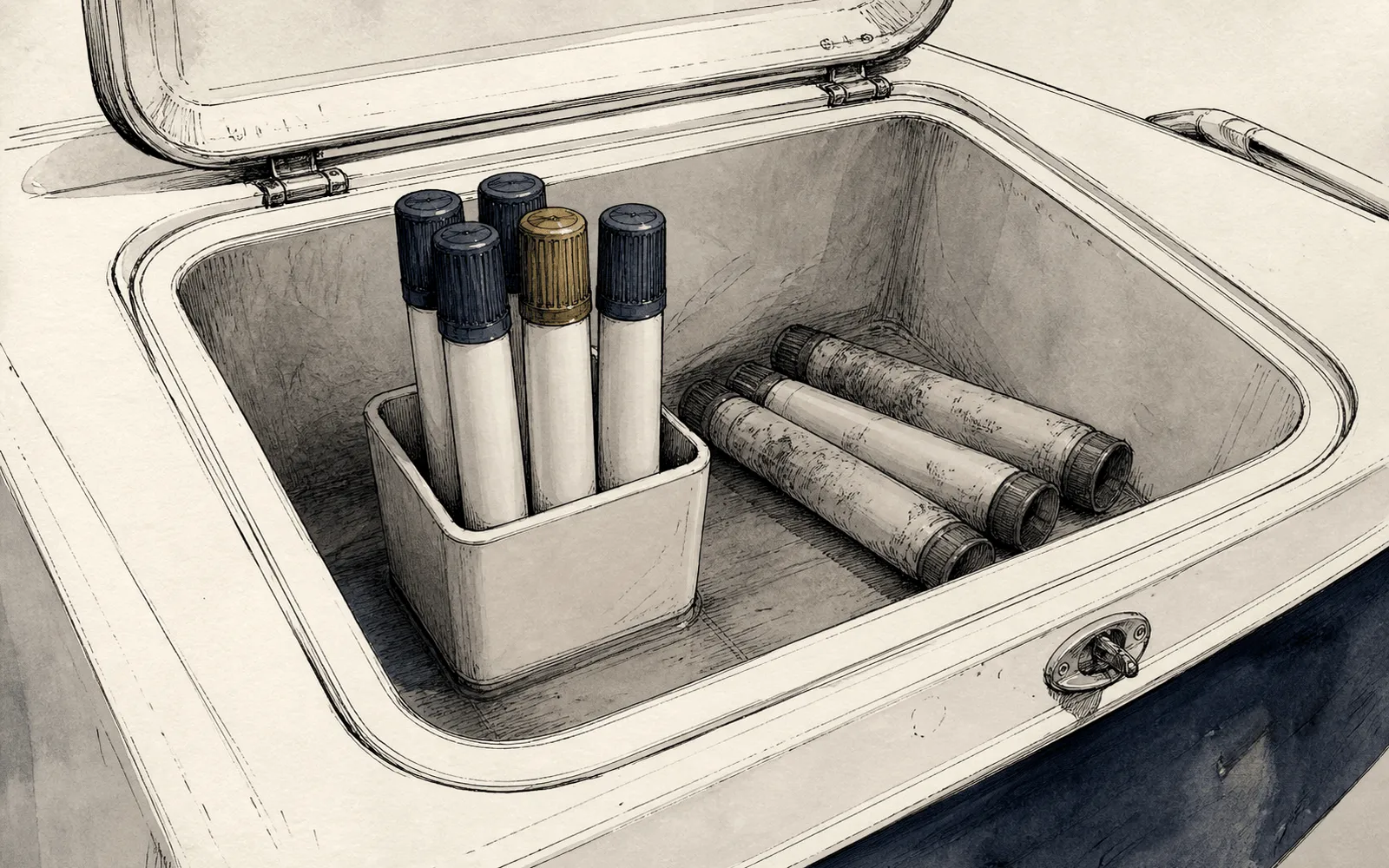
There is a specific kind of problem that regulation creates and then declines to finish. Marine flares are the cleanest example afloat: you must carry them, you must replace them on a schedule, and no federal agency will tell you where the old ones go.
For the short answers — do they expire, what must you carry, how do you get rid of them — see the guide: do marine flares expire, and how do you dispose of them? What follows is the regulation itself, and where it stops.
What are you actually required to carry?
Three day signals and three night signals — or three devices rated for both. The rule is 33 CFR Part 175, Subpart C, and it applies on coastal waters, the Great Lakes, territorial seas, and connected waters up to the point where the waterway narrows below two nautical miles.
§175.110 splits it by boat length. Boats 16 feet and over need day and night signals aboard at all times. Boats under 16 feet need night signals only, and only between sunset and sunrise.
Table 175.130 is where the actual arithmetic lives:
| Device | Approval | Covers | Qty |
|---|---|---|---|
| Hand-held red flare | 46 CFR 160.021 | Day and night | 3 |
| Red aerial flare (meteor or parachute) | 160.066 | Day and night | 3 |
| Hand-held or floating orange smoke | 160.022 / .037 / .057 | Day only | 3 |
| Electric distress light | 46 CFR 161.013 | Night only | 1 |
| Orange distress flag | 46 CFR 160.072 | Day only | 1 |
Read the “covers” column before you buy. Three orange smoke signals is a common purchase and it satisfies exactly half the requirement. Three hand-held red flares satisfies all of it with three items, because that device is rated for both.
The cheapest fully compliant kit that isn’t pyrotechnic at all is two items: an orange flag for day, an approved electronic signal for night.
How long do flares last, and what does the date mean?
A pyrotechnic signal may be marked with a service life of no more than 42 months from manufacture. That’s the regulation, not a manufacturer convention — 46 CFR 160.021-5 for hand-held red flares says “The expiration date must be not more than 42 months from the date of manufacture,” and 160.066-10 says the same for aerials.
Note the wording: 42 months is a ceiling on what the manufacturer may print, not a length the Coast Guard grants you. A given flare may be stamped shorter. Read the expiration date, not the manufacture date — the flare carries both, and on hand-helds the manufacture date is die-stamped into the wooden handle.
You’ll see “three years” repeated widely. It’s wrong by six months, and it comes from people rounding.
Expired flares may legally stay aboard as extras. The Coast Guard’s own Boater’s Guide says so: “Expired signals may be carried as extra equipment but cannot be counted toward meeting the visual distress signal requirement.” Keeping the old set is arguably good practice — in a real emergency more burn time is more burn time. It just doesn’t count on a boarding.
Can you fire off the old ones for practice?
No. It’s a federal felony, and the statute is specific. 14 U.S.C. § 521(c) makes knowingly and willfully communicating a false distress message to the Coast Guard, or causing it to launch when no help is needed, a class D felony, subject to a civil penalty of not more than $10,000, and leaves you “liable for all costs the Coast Guard incurs as a result.”
You’ll often see this quoted as “six years and $250,000.” Those figures are real but derived — a class D felony carries up to six years under 18 U.S.C. § 3581(b)(4), and the maximum individual felony fine is $250,000 under § 3571(b). Section 521 itself names only the felony class, the $10,000 civil penalty and the cost recovery.
Separately, 33 CFR 175.140 prohibits displaying a distress signal at all “except a situation where assistance is needed because of immediate or potential danger to the persons on board.” No New Year’s Eve exception.
Can they go in the trash?
No. The EPA classifies them as explosive hazardous waste by name — its explosive hazardous wastes page covers “commercial and consumer fireworks; marine, roadside and signal flares; and hobby rockets.”
Household-generated waste is exempt from federal RCRA Subtitle C, which is exactly why the answer becomes a state and county patchwork. California’s Division of Boating and Waterways is unusually direct: expired pyrotechnic flares are “hazardous waste, as they are toxic, reactive, and ignitable,” and “never put flares in the regular trash or in any waterway, it is illegal and can endanger solid waste workers or our waterways.”
Soaking them in water and throwing them out — the folk remedy — is not a solution either. Rutgers’ extension service notes it simply “creates a pollution problem.”
So where do they actually go?
This is the part that has no good answer, and pretending otherwise would be doing you a disservice.
California DBW reports that only two permitted facilities in the entire United States accept explosive waste streams — one in Missouri, one in Illinois. California has none.
The California Coastal Commission’s disposal factsheet states that two of California’s fifty-eight counties — Alameda and Santa Cruz — accept expired marine flares at their household hazardous waste facilities. In the state that generates an estimated 174,000 expired marine flares a year. The Commission says plainly that “the lack of locations for proper disposal of expired marine flares is a problem in California.”
New Jersey does better: Rutgers lists seven county programs that accept them — hand-helds only, no flare guns.
The realistic routes, in rough order of likelihood:
- Your county household hazardous waste program. Call first. Expect to be told no.
- The local fire department. Both California sources say to contact them for help identifying options — neither says fire departments accept them. Some will take them for training.
- Coast Guard Auxiliary or a Power Squadron. They use expired flares in training classes, and both organizations have publicly suggested donating them. Ad hoc, but real.
- A marine retailer take-back. We could not find a single manufacturer or government source confirming a national program. If someone tells you a chain accepts them, verify locally before driving there.
What about the Coast Guard’s own guidance? The current Boater’s Guide acknowledges that “disposal of these devices can also be a problem depending on jurisdiction” — and then stops. Its inspection flyer says only to check the date and replace expired ones. So the federal government requires you to buy them, requires you to replace them every 42 months, and offers no instruction on what to do next.
Naming that clearly is more useful than a tidy answer that doesn’t exist.
Do electronic distress lights solve this?
Partly — they solve the night half, and they end the disposal problem entirely.
An electronic visual distress signal device meeting RTCM Standard 13200.0 (21 June 2018) is accepted as a night signal under 33 CFR 175.130. The Coast Guard’s own explainer, What is an equivalent eVDSD?, is unambiguous about the limit: “The standards for daytime signaling device(s) (e.g., handheld flares and/or the orange distress flag) have not changed.”
So an eVDSD plus an orange flag is a complete, permanent, non-expiring kit. Approved units are marked “Complies with RTCM Standard 13200.0 for an eVDSD”; the underlying approval subpart, 46 CFR 161.013, requires automatic SOS in Morse, at least six hours of power, and survival afloat.
The trade is brightness. An approved eVDSD averages around 50 candela; the CFR floor for a hand-held red flare is 500 candela for at least two minutes (160.021-4). Electronics win on duration and on never expiring. Pyrotechnics win on raw intensity by an order of magnitude, which matters when a searchlight is sweeping and you get one chance to be seen.
What do the pyrotechnics themselves do?
Orion makes most of what’s sold in the US, out of Easton, Maryland, with plants in Peru, Indiana and Bristol, Pennsylvania — nearly a century of making flares under the Bristol Flare, Lakeside Fusee and Standard Fusee names before consolidating as Orion in November 1997.
Published performance, from their own product pages:
| Device | Output | Duration |
|---|---|---|
| 25 mm red aerial | up to 33,000 candela, to ~375 ft | ~7 seconds |
| 12-ga red aerial | up to 16,000 candela, to ~500 ft | ~7 seconds |
| Hand-held red flare | 700–950 candela | ~3 minutes |
| SOLAS parachute rocket | 30,000 candlepower, to 1,150 ft | 40 seconds |
| Orange smoke | — | ~1 minute |
That table is the whole tactical argument. An aerial is one brief, very bright event that says look over here across a long distance. A hand-held is three minutes of continuous I am here once somebody is already looking. The SOLAS parachute rocket is the only device that does both, by hanging under a canopy.
One caution worth the price of the article: the altitude figures are manufacturer claims, not compliance thresholds. 46 CFR 160.066-7 sets no minimum altitude for an aerial flare. Its actual requirements are burn vivid red for at least 5.5 seconds, peak at least 10,000 candela, total output at least 1,000 candleminutes, and — the one people don’t expect — “burn out completely before falling back to the level of launch.”
And check the approval, not the marketing. Orion’s own #809 “Day & Nighttime Flare/Smoke Signal” states on its product page that it “is neither USCG nor SOLAS approved.” It is a perfectly good signal that satisfies no part of the federal requirement.
How do you use one without hurting yourself?
The regulation itself anticipates that these devices burn people: 46 CFR 160.066-7 requires a signal to “function in a manner that would not cause burns or injury to an unprotected person firing the signal in accordance with the manufacturer’s instructions.” That clause exists because the failure mode is common enough to legislate against.
The published technique, from the United States Power Squadrons:
- Hold hand-helds out over the side, so slag and burning residue drip into the water rather than onto your deck or your tender.
- Fire downwind, so what comes off the flare goes away from you and the boat.
- With an aerial pistol, point high overhead with your arm extended before cocking it, and don’t look up at it.
Store them somewhere dry, accessible, and marked — a waterproof container labeled “Distress Signals” is the standard advice, and it survives the moment when someone else on board has to find them.
The short version
Buy the combination that actually covers day and night — check the column, not the count. Diary the expiry, because it’s 42 months and it will lapse quietly. Then, before you need to replace them, phone your county hazardous waste program and your local fire department and find out now what they’ll take, because the answer varies by county and there is no national one.
And keep the expired set aboard. It doesn’t count for the inspection, and on the worst day of your life it’s still three more minutes of light.
Full write-up on the manufacturer is on the Orion brand page. We use and recommend Orion; nobody paid for this, and when they become a stockist we’ll say so on the page. Regulations change and vary by jurisdiction — this is a starting point, not legal advice.