Do marine flares expire, and how do you dispose of them?
Short answer
Yes. Pyrotechnic marine distress signals carry an expiry date stamped on each unit, and expired signals do not satisfy the US carriage requirement. Disposal is genuinely unresolved: they are pyrotechnics, they cannot go in household trash, and firing them off is a false distress alert and illegal. Routes vary by locality — ask marine patrol, the fire department or your hazardous-waste program.
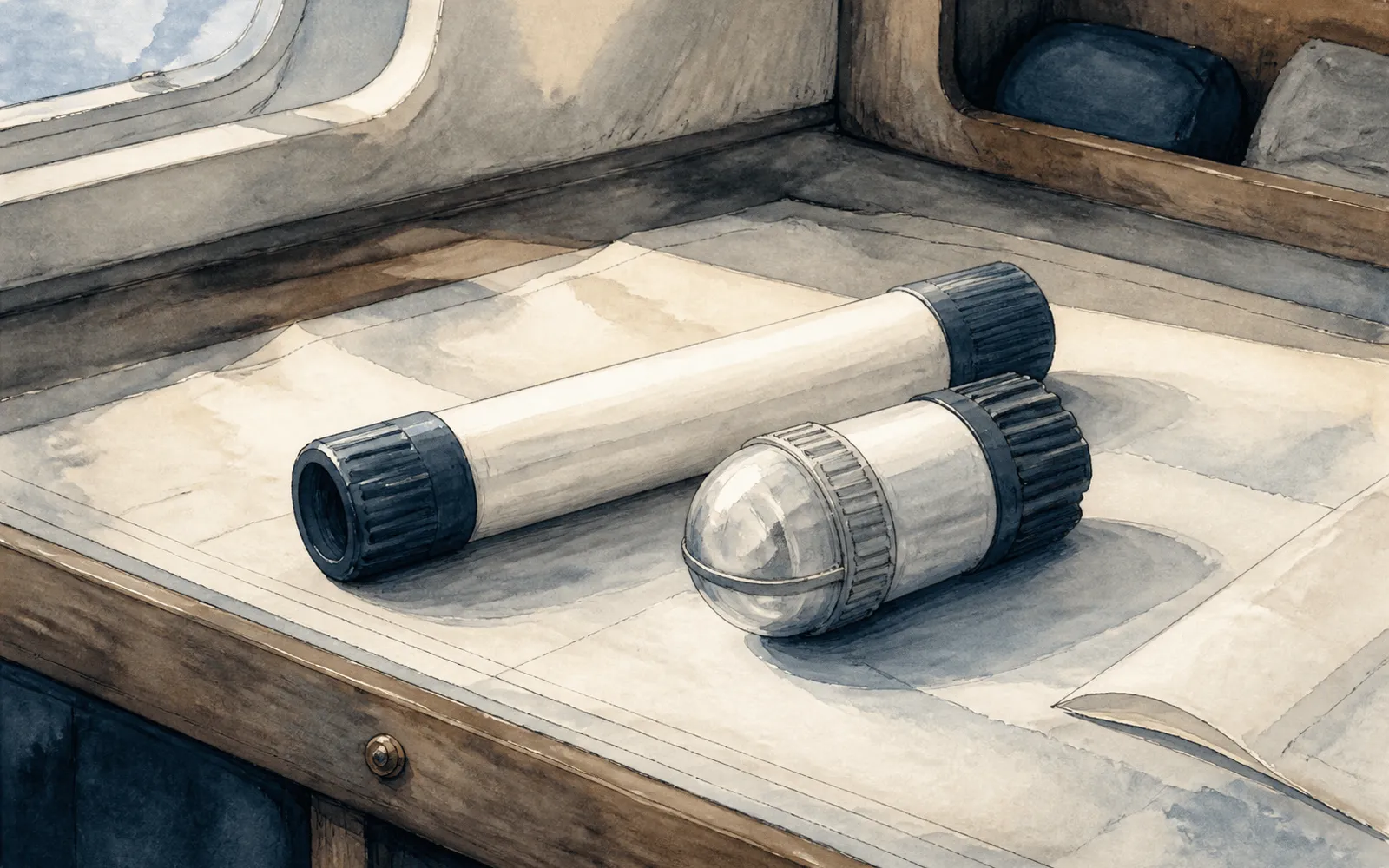
Almost everything else on a boat is a choice. Visual distress signals are a federal carriage requirement on a lot of US waters — which means most boat owners have a flare kit, and a striking number of those kits are past their date.
Do marine flares expire?
Yes. Every pyrotechnic distress signal carries an expiry date stamped on the unit, and in the United States expired pyrotechnic signals do not count toward the carriage requirement. A locker full of out-of-date flares leaves you non-compliant on paper and under-equipped in fact.
Most people discover this during an inspection. A smaller and unluckier group discovers it while trying to use one.
Why do they expire, when they look fine?
Because the chemistry ages, and because storage does most of the damage.
Orion, the American house whose flares are in most US boat lockers, says plainly that signal performance can be degraded by poor storage and recommends inspecting signals at least annually. Consider where a flare kit actually lives: a damp locker, five summers of heat cycling, salt air, and no opportunity whatsoever to test the product without destroying it and committing a federal offence.
That last clause is not a joke, and it leads directly to the next question.
Can you fire off expired flares to use them up?
No. This is the most common bad advice in boating and it needs saying plainly.
Firing a distress signal when you are not in distress is a false distress alert. It can launch a search-and-rescue response. It puts responders in harm’s way for nothing. It is illegal. And “we were just getting rid of the old ones” has never once been a satisfactory explanation to a Coast Guard station.
The same principle applies to a 406 MHz beacon: you do not test it by activating it.
So how do you actually dispose of them?
Here is the honest answer, which is less satisfying than it should be: there is no single national consumer route in the United States, and practice varies by state and municipality.
What is certain:
- Expired flares are pyrotechnics. They do not go in household trash or recycling.
- They should not be dumped, buried, burned in a fire pit, or thrown overboard.
- Firing them is out, per above.
What to do:
- Call your local marine patrol or harbourmaster and ask what they accept.
- Ask the fire department — some accept them, some do not, and it is entirely local.
- Check your household hazardous waste program. Many run periodic collection events, and pyrotechnics are sometimes included.
- Ask the retailer or marina at the point of purchase whether they run a take-back.
Store expired signals separately from current ones in the meantime, clearly marked, so nobody grabs the wrong handful in an emergency.
We would rather tell you this is unresolved than pretend there is a tidy answer. It is a genuine gap in how a mandatory consumer product is managed at end of life, and knowing that before you own four expired kits is worth something.
What are you actually required to carry?
Under 46 CFR Part 160, marine pyrotechnic distress signals are type-approved by the Coast Guard. Broadly, many recreational vessels operating on coastal waters, the Great Lakes, territorial seas and connected waters must carry current day and night signals — with real variation by vessel size, water and use, and with specific exemptions.
Check the rules for your own vessel rather than a summary in an article, including this one. Getting it wrong is a citation, and the details are not uniform.
What should be in the kit?
| Item | Covers | Expires? |
|---|---|---|
| Aerial signal kit (meteor / parachute) | Night, long range | Yes |
| Handheld red flare | Day and night, close range | Yes |
| Orange smoke signal | Day | Yes |
| Orange distress flag | Day | No |
| Electric distress light | Night, different rules apply | No |
The cheapest good decision on this page: buy the orange distress flag too. It never expires, creates no disposal problem, produces no burns, and covers the daytime side. It costs almost nothing and it is the item people forget.
Electric distress lights are worth understanding before you assume they replace pyrotechnics — they don’t expire, but they fall under different rules, so confirm what your vessel is required to carry.
Where flares sit relative to a beacon
A flare is a line-of-sight device. It says here, now, look to somebody already in the area.
That is a completely different job from what an ACR or McMurdo 406 MHz beacon does — telling a government satellite system your identity and position from anywhere on earth, with no subscription.
The order matters: the beacon starts the search, the flare finishes it. Anyone who has watched a search aircraft pass a mile off understands why the close-range layer still exists in an age of satellites.
And one practical note that costs nothing: handheld flares burn extremely hot and drip. Gloves are not optional, and the instruction to hold it downwind and outboard is on the label for a reason.
Quick answers
- Do marine flares expire?
- Yes. Pyrotechnic visual distress signals carry an expiry date printed on each unit. In the United States, expired pyrotechnic signals do not count toward the Coast Guard carriage requirement, so a locker full of out-of-date flares leaves a vessel non-compliant as well as under-equipped.
- Can I fire off expired flares to get rid of them?
- No. Firing a distress signal when you are not in distress is a false distress alert. It can launch a search-and-rescue response, it puts responders at risk, and it is illegal. It is also the single most common piece of bad advice given about expired flares.
- How do I dispose of expired marine flares?
- There is no single national consumer route in the United States, and practice varies by state and municipality. Expired flares are pyrotechnics and must not go in household trash or recycling. Contact your local marine patrol, fire department, or household hazardous waste program and ask what they accept; some areas run periodic collection events.
- What distress signals are US recreational boats required to carry?
- Requirements are set by the Coast Guard and vary by vessel size, the waters you operate on and how the boat is used, with specific exemptions. Broadly, many recreational vessels on coastal waters, the Great Lakes, territorial seas and connected waters must carry current day and night signals. Check the current rules for your own vessel and water rather than relying on a summary.
- Is there a non-expiring alternative to pyrotechnic flares?
- Partly. An orange distress flag covers the daytime side and never expires. Electric distress lights address the night side without pyrotechnics or an expiry date, but they fall under different rules than pyrotechnic signals, so confirm what your vessel is required to carry before treating one as a straight replacement.
Brands in this guide
- OrionEaston, Maryland — flares, smoke and signal kits made in Indiana and Pennsylvania, for the one federal requirement most boaters discover has quietly expired.
- ACR ElectronicsFort Lauderdale, since 1956 — the rescue beacon that talks to a government satellite system and never asks for a subscription.
- McMurdoDistress beacons and marine safety electronics, with service and registration part of the purchase.