Do I need a spotting scope or will binoculars do?
Short answer
Binoculars are enough if you want to walk with the optic, look in short bursts, or work inside a few hundred yards. Buy a spotting scope when you need to resolve detail at distance from a fixed position — and budget for a tripod, because an 85 mm scope at 60x has about a 1.4 mm exit pupil.
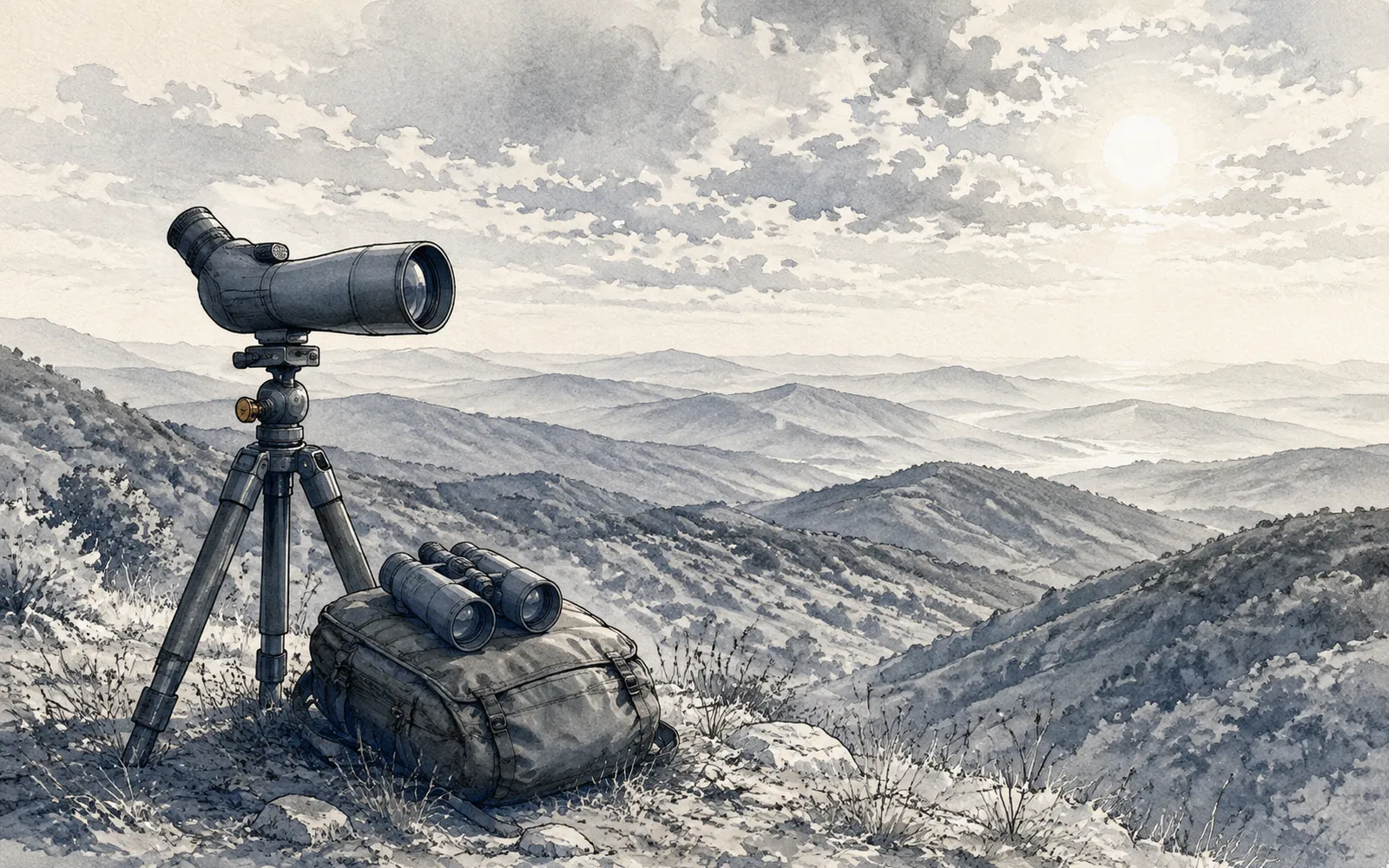
The question usually gets answered with magnification, and magnification is the least useful part of it. A 20-60x scope sounds like six times the binocular, and on the page it is. In the field it is a different instrument with different prerequisites, and two of them — a tripod and good light — are things you either have or don’t.
Here is the honest crossover, in the three terms that actually decide it: how much light reaches your eye at the magnification you’ll really use, whether you can hold the thing, and how long you intend to sit behind it.
What does a spotting scope give you that binoculars don’t?
Reach that a hand-held optic cannot reproduce, bought with a tripod and a smaller exit pupil. The binocular numbers — magnification, objective, and the 8x42 versus 10x42 question — are covered in what 8x42 and 10x42 mean, and this guide doesn’t repeat them.
What a scope adds is resolving power on a static subject: reading a band on a gull’s leg, counting points across a canyon, calling shots on paper. What it takes away is mobility and light. Vortex states the mechanism plainly in its own guidance: higher magnification amplifies hand movements and vibrations, making a tripod essential for a steady image, and it can lead to a dimmer image in low light.
If your question is “how far away is that,” a scope is the wrong tool — see what a rangefinder’s max range figure means.
Why is the top of the zoom range often unusable?
Because exit pupil collapses as magnification climbs, and at 60x an 85 mm objective is feeding your eye a beam about 1.4 mm wide.
Exit pupil is approximately the objective diameter divided by magnification. Vortex publishes no exit pupil figure for the Diamondback HD 20-60x85, so here is our arithmetic, not Vortex’s: 85 ÷ 20 = 4.3 mm at the bottom of the zoom, 85 ÷ 60 = 1.4 mm at the top.
Where a maker publishes the figure, use theirs. Leupold publishes 4.1 mm and 1.4 mm for the SX-4 Pro Guide HD Gen 2 20-60x85 — slightly under our arithmetic at the wide end. Hawke publishes 3.4 mm to 1.1 mm for the Endurance ED 25-75x85. Bushnell publishes 1.2-3.3 mm for the Prime 20-60x65.
And then there is the case that proves why we label the arithmetic. ZEISS publishes 2.50 mm at 22x for the 85 mm Victory Harpia. Divide 85 by 22 and you get 3.9 mm. ZEISS does not explain the gap on the data sheet and we won’t invent a reason — take it as evidence that objective ÷ magnification is an estimate, not a specification.
The practical consequence: a 1.4 mm exit pupil is a bright-daylight setting. Wind the zoom back and the image gets brighter, steadier and wider. On these published figures the useful working band of a 20-60x scope sits a good deal nearer the bottom of the range than the top.
Is a spotting scope really a scope-plus-tripod purchase?
Yes, and the tripod is not a rounding error. Vortex lists the Diamondback HD 20-60x85 angled at $699.99 MSRP. On Vortex’s own tripod page, the cheapest complete tripod is $224.99 MSRP and the most expensive is $1,299.99 MSRP. That is roughly a third of the scope’s price at one end and nearly double it at the other — our arithmetic on their published prices.
Load rating is rarely the constraint. Vortex’s tripod guidance describes a 22-pound maximum load as enough to hold “even the largest spotting scopes”, and the scopes here weigh 60.9 oz (Vortex Diamondback HD 85), 78.2 oz (Leupold SX-4 Pro Guide HD Gen 2 85) and 1,934 g without eyepiece (ZEISS Victory Harpia 85). Every one of those sits far inside a 22-pound rating. What the money above the entry point buys is stiffness and a head that pans without stepping — which is a judgment, not a published number.
Should you buy an angled or a straight body?
Angled for shared, prolonged and upward viewing; straight for vehicle windows, downhill glassing and fast target acquisition. The two makers who publish guidance on this agree, which is worth something.
Vortex says angled bodies are “perfect when you plan on sharing the view with people of different heights” and “far more comfortable for glassing upward at steep angles,” while straight bodies “shine” mounted on a car or truck window, make “glassing at a steep downward angle more comfortable,” slide in and out of a pack faster, and are “a much more intuitive way to glass” because your eyes are already pointed at the target. Leupold says the same in fewer words: straight is more comfortable seated in a truck and glassing downhill, angled is more comfortable “when glassing for prolonged periods.”
Note what is not a reason to choose. Vortex’s own angled and straight Diamondback HD 20-60x85 differ by 0.2 inches of length and 0.4 ounces of weight. This is an ergonomics decision, not a packing one.
Why are close focus and field of view harder to compare than they look?
Because makers publish them at different reference distances, in different units, and sometimes not at all.
| Scope | Exit pupil, top of zoom | Field of view, as published | Close focus, as published | Eye relief, as published |
|---|---|---|---|---|
| Vortex Diamondback HD 20-60x85 | 1.4 mm (ours) | 108’–60’ @ 1000 yds | 24.6’ | 18.3–20.3 mm |
| Leupold SX-4 Pro Guide HD Gen 2 20-60x85 | 1.4 mm | 91.7–50.6 ft @ 1000 yds | 35 ft | 19 / 17.8 mm |
| Nikon MONARCH 82ED + MEP-20-60 | 1.4 mm | 37–17 m at 1,000 m | 5.0 m | 16.1–15.3 mm |
| ZEISS Victory Harpia 85 (22–65x) | 1.31 mm | 63.2–21.0 m/1000 m (189.6–63.0 ft/1000 yds) | 3.5 m | not published |
| Leica APO-Televid 82 + 20–60x | 1.4 mm | 105–60 ft @ 1000 yds (35–20 m) | approx. 12.8 ft / 3.9 m | not published |
| Hawke Endurance ED 25-75x85 | 1.1 mm | 90–46.5 ft @ 1000 yds; 30–15.5 m @ 1000 m | 26.2 ft | 20 mm |
| Bushnell Prime 20-60x65 | 1.2 mm | not published | 20 ft | 18 mm |
Every exit pupil above is the manufacturer’s published figure except the Vortex row, which is ours (85 ÷ 60). Magnification ranges differ between rows, so the top-of-zoom column is not a like-for-like comparison — the Harpia’s 1.31 mm is at 65x and Hawke’s 1.1 mm is at 75x.
Two things fall out of that table. First, field of view is quoted at 1,000 yards in feet by the US-facing brands and at 1,000 meters by Nikon, whose column header reads “Field of view at 1,000 m/yd. (m)”. They describe the same angle, but you cannot read them side by side without converting, and the differences that survive conversion are real: ZEISS’s Harpia gives 189.6 ft at 22x where the Vortex gives 108 ft at 20x.
Second, close focus varies by nearly a factor of three inside one objective class, from Leica’s approximately 12.8 ft on the APO-Televid 82 up to Leupold’s 35 ft. If you watch butterflies, dragonflies or a feeder, that number matters more than the top of the zoom. Hawke’s spec tables even print the metric close-focus value with the wrong unit symbol on at least two products — read the maker’s page, not a retailer’s transcription of it.
What should eyeglass wearers check?
Eye relief — and on a spotting scope you may not find it published at all. The 15 mm threshold for eyeglass wearers is covered in the 8x42 guide; what is different here is availability.
Nikon publishes 16.1–15.3 mm for the MEP-20-60 zoom eyepiece, which means at 60x it sits essentially on the threshold Nikon itself gives for glasses. Vortex publishes a range of 18.3–20.3 mm but does not tie either end to a magnification, so you cannot tell what you get at 60x. Hawke and Bushnell publish single figures — 20 mm and 18 mm — with no range at all. And ZEISS publishes no eye relief on either the Victory Harpia or the Conquest Gavia data sheet, while Leica publishes none on its zoom eyepiece sheet either. If you wear glasses, try before you buy or ask the maker directly; there is no number to borrow.
Can you take pictures through one?
Yes, but check the adapter before you buy the scope, because compatibility is model-specific and some makers don’t sell one. Hawke lists a Digi-Scope Smart Phone Adaptor, model 64031, at $34.00. Nikon’s path is narrower: its digiscoping eyepieces fit Fieldscope II and ED78 series bodies but not the Fieldscope I series, a COOLPIX needs the matching FSB-series camera bracket, and EDG Fieldscopes need the EMA-1 eyepiece mount adapter. Vortex’s own spotting scope accessories page lists ten items and none of them is a phone or digiscoping adapter.
Whatever you attach, the glass does the work: dispersion control shows up hardest at high magnification, covered in what ED glass actually does, and what you are paying for in optics applies to scopes as much as to binoculars.
The short version
Binoculars are the right answer more often than the catalog suggests: you can carry them, hold them, and use them in the light you actually have. Cross to a spotting scope when you need to resolve detail from a fixed position, you’re willing to carry and set up a tripod, and you accept that the top third of the zoom is a fair-weather setting — an 85 mm objective at 60x is handing your eye a 1.4 mm beam. Budget the tripod with the scope, not after it. Choose angled if the optic will be shared or aimed upward and straight if it lives on a truck window, then check close focus and eye relief against the published figures before you commit, remembering that several respected makers publish no eye relief at all.
Quick answers
- Why does a spotting scope get dimmer at the top of its zoom range?
- Because the exit pupil shrinks as magnification rises. Exit pupil is roughly the objective diameter divided by magnification, so an 85 mm scope falls from about 4.3 mm at 20x to about 1.4 mm at 60x. Leupold publishes 4.1 mm and 1.4 mm for its own 20-60x85, and Hawke publishes 3.4 mm down to 1.1 mm for a 25-75x85. A beam that narrow is a bright-daylight setting, which is why the useful working band sits nearer the bottom of the zoom.
- How much does the tripod add to the cost of a spotting scope?
- Enough that it belongs in the budget from the start. Vortex lists its Diamondback HD 20-60x85 angled spotting scope at $699.99 MSRP, and the tripods on its own tripod page run from $224.99 for an aluminum model with a pan head to $1,299.99 for a carbon model with a ball head. That is roughly a third of the scope's price at the low end and nearly double it at the high end.
- Should you buy an angled or a straight spotting scope?
- Angled if several people of different heights will share it or you glass upward; straight if you glass from a vehicle window, glass downhill, or want to find your subject fast. Vortex says angled bodies are "far more comfortable for glassing upward at steep angles" while straight bodies are "a much more intuitive way to glass." Size is not the deciding factor — Vortex's own angled and straight Diamondback HD 85 differ by 0.2 inches and 0.4 ounces.
- Why do published close focus distances vary so much between spotting scopes?
- Because close focus is an optical design choice, not a standardized figure, and makers target different users. Among 80-to-85 mm scopes, Leupold publishes 35 feet for the SX-4 Pro Guide HD Gen 2, Vortex publishes 24.6 feet for the Diamondback HD, Leica publishes approximately 12.8 feet for the APO-Televid 82, and ZEISS publishes 3.5 m for the Victory Harpia 85. That is a threefold spread within one objective class.
- Do spotting scope manufacturers publish eye relief figures?
- Some do and some don't. Vortex publishes 18.3-20.3 mm for the Diamondback HD 20-60x85, Leupold publishes 19 mm and 17.8 mm at the ends of its 20-60x85 zoom, Nikon publishes 16.1-15.3 mm for the MEP-20-60 eyepiece, and Hawke and Bushnell publish single figures of 20 mm and 18 mm. ZEISS publishes no eye relief on the Conquest Gavia or Victory Harpia data sheets, and Leica publishes none on its zoom eyepiece data sheet.
Brands in this guide
- Vortex OpticsWisconsin, 2002 — a family bird-feeder shop that became an optics company, and a warranty so broad it turned into the product.
- ZEISSJena, 1846 — owned by a foundation rather than shareholders, and the binocular you buy comes from a division most people don't know exists.
- LeupoldOregon, 1907 — five generations, one factory, and a company that will tell you exactly which of its own products are made there.
- NikonJapan, 1917 — one of the great optical houses, still building excellent binoculars, and out of the riflescope business since around 2019.
- LeicaBinoculars, spotting scopes, and rangefinding optics for observation in the field.
- Hawke OpticsSuffolk, England — a family optics house that grew out of a garage, sells serious glass at unserious prices, and does not tell you where it's made.
- BushnellOutdoor optics across accessible price points, from compact binoculars to spotting scopes.