What is the difference between first and second focal plane?
Short answer
In a first focal plane scope the reticle scales with the image, so its spacing is true at every magnification. In a second focal plane scope the reticle stays one size and its spacing is true at one setting only — usually the top of the zoom range, but makers rarely print which.
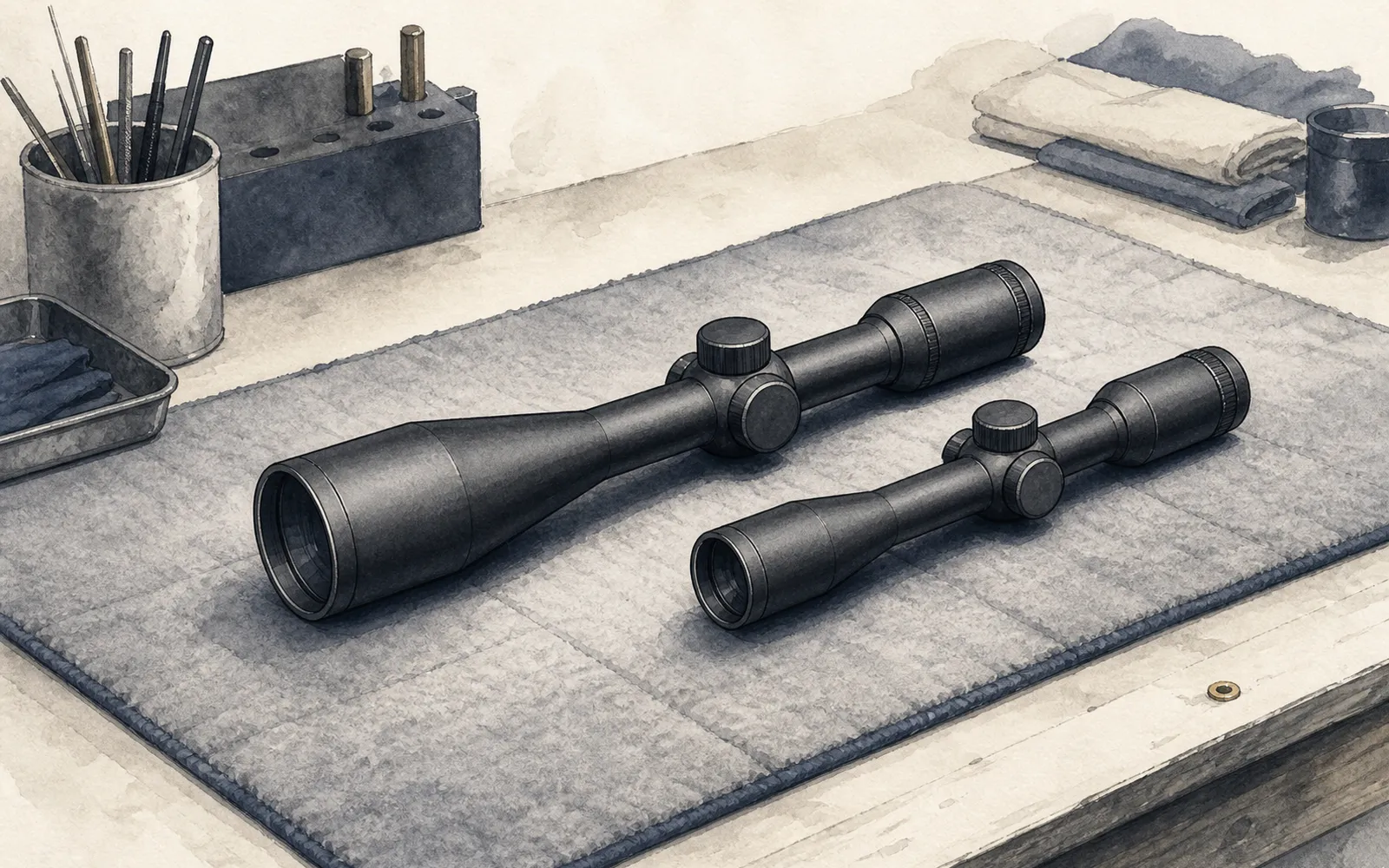
Two scopes can carry the same reticle drawing, the same magnification range and the same turret clicks, and behave differently the moment you touch the zoom ring. The difference is where inside the tube the reticle is etched.
Every maker explains that mechanism. Almost none of them prints the one number that makes a second focal plane holdover reticle usable — the magnification its marks were drawn for. We opened seven manufacturers’ own pages to see who does.
Where does the reticle sit, and what does that change?
In a first focal plane scope the reticle is etched ahead of the erector — the lens group that does the zooming — so the zoom enlarges reticle and image together; in a second focal plane scope it sits behind the erector, so only the image changes size. Leupold describes the first case as the reticle being “placed before the erector system (magnifying lenses), so when you zoom in, the reticle is magnified along with the image”. Bushnell puts the second the other way round: “the crosshairs of the reticle will remain the same size through the lens, no matter the magnification setting you’re on”.
Naming is not consistent, which matters when you read a spec sheet. Leupold’s blog calls them front and rear focal plane while its shop pages say first and second. Bushnell writes “second, or rear, focal plane”. Steiner puts RFP straight into the model name. ZEISS says “second image plane”. Two positions, four labels.
Why does a first focal plane reticle get hard to see at low power?
Because the reticle shrinks along with everything else, so at the bottom of the zoom range the finest marks can drop below what your eye separates from brush or a dark background. Vortex Optics is blunt about it: the reticle at an FFP scope’s lowest magnification, “which is also the magnification that provides best low-light performance,” is “often so tiny you can hardly see it”. Leupold says the same in fewer words — at low magnifications “the reticle will not be as visible”. Bushnell lists FFP as “difficult to see in low light at low power”.
The reverse happens at the top of the dial. Hawke Optics states that in a first focal plane scope “the reticle will be very thick on high magnification” — the stadia grow with the target, so a fine crosshair at 4x is a heavy one at 24x, covering more of what you are aiming at. Neither end of that is a marketing complaint. It is the price of a reticle that scales.
Why do second focal plane scopes still dominate hunting?
Because a reticle that never changes size stays equally usable at 3x and at 15x, which is what you want in poor light and thick cover. Vortex’s case for SFP is that “even when they have it on the lowest magnification, the reticle remains its normal size, more visible in the brush or timber, especially in low light”. Leupold sells SFP on the same basis, calling those reticles “ideal for low-light hunting situations and in scopes that don’t utilize hash marks for range estimation”.
That last clause is the tell. A plain duplex has nothing to calibrate. The trouble starts the moment the reticle acquires marks you are meant to hold on.
At what magnification is a second focal plane holdover reticle actually correct?
At one magnification, picked by the maker, and it is usually — not always — the top of the zoom range. Vortex says the calibration point is “usually the highest magnification, where the reticle and image are at the same scale”. Leupold’s reticle manual is the most careful statement we found: an SFP reticle “is calibrated to a specific magnification for range estimating purposes. In a variable-magnification scope, this is generally the highest magnification setting and all range estimating must be performed at this setting. However, in certain scopes it may be calibrated for a different setting”. The manual then tells you to contact Leupold Technical Service to find out which setting your scope uses.
Hawke supplies the counterexample by name: “the Hawke 10x Mil-Dot reticle is designed to give true Mil spacing when on 10x magnification”. On a Hawke scope that tops out at 16x, 10x is not the top of the dial.
| Maker | What its own material says about SFP calibration | Is the magnification on the buying page? |
|---|---|---|
| Vortex Optics | “Usually the highest magnification, where the reticle and image are at the same scale” | No — the Crossfire II 4-12x50 AO and the Viper HD 3-15x44, both Dead-Hold BDC, list “Second Focal Plane” and no calibrated power |
| Leupold | “Generally the highest magnification setting… However, in certain scopes it may be calibrated for a different setting” | No — the manual sends you to Technical Service |
| Hawke Optics | “Most SFP reticles are designed with their aimpoints calibrated on a specific magnification”; the 10x Mil-Dot is true at 10x | No — the Vantage IR 4-16x50 AO Mil Dot IR page gives the focal plane and nothing else |
| ZEISS | Marks hold “at the respective reference magnification” | No — neither the Conquest V4 page nor the ZMOAi-T30 datasheet states the number |
| Bushnell | “Only accurate at one power setting on a second, or rear, focal plane” | No — no power is named |
| Steiner | The MHR (RFP) page describes BDC subtension marks | No — and the H6Xi manual labels the RFP models “Focal Plane Second” without a calibrated power |
| Leica | The Amplus 6 technical data lists “2nd focal plane” | No — the 3-18x44i L-Ballistic BDC MOA page gives neither the plane nor the power |
Checked on the pages linked above in September 2026. A calibration figure may exist in a manual packed in the box; we could only open what is published on the web.
What goes wrong if you hold over at the wrong magnification?
Every mark is worth a different angle than the diagram says, and the error grows the further you are from the calibrated power. Leupold gives the arithmetic in one line: at half magnification, “your Mil would really be two Mils”. Bushnell states the constraint flatly — “a reticle and its subtensions are only accurate at one power setting on a second, or rear, focal plane”. Whether the marks are drawn in mils or MOA doesn’t change that; see which unit to buy for that separate decision.
The failure is quiet. Nothing looks wrong — the reticle is crisp, the target is in focus, the second hash below center looks exactly as it did in the catalog image. It just isn’t worth what the drawing says unless the zoom ring is where the maker put it. A first focal plane reticle removes that failure mode: Leupold’s claim for FFP is that it “allows you to accurately use the reticle feature at any magnification setting”, and Vortex says the same, that with FFP “the reticle’s sub-tensions remain accurate at all magnification levels”. For a target or competition shooter who ranges with the reticle and shoots at whatever power the light allows, that is the entire argument.
Do illuminated reticles change the answer?
Illumination fixes visibility, not calibration — a lit FFP reticle is easier to find at low power, but a lit SFP reticle is still true at one magnification only. Hawke’s response to the thin-reticle problem is structural: “Hawke have ensured all FFP scopes are illuminated, so even if the reticle begins to appear small on lowest magnification setting, you can turn on the illumination and still easily see the aimpoints”.
What gets lit varies, and it is worth checking before you buy. Vortex states that its Viper HD second focal plane options “only illuminate the center dot”, while the Viper HD and Razor HD LHT first focal plane reticles “illuminate the entire vertical and horizontal stadia”. Leica quotes the illuminated dot size on the Amplus 6 at a stated 10x magnification — a reminder that in a second focal plane scope even the dot’s angular size is a function of where the zoom ring sits.
Why does a first focal plane scope cost more?
Two of the seven makers explain it in their own words, and both point at the same thing: putting the reticle in front of the erector is harder to build. Vortex writes that getting the glass-etched reticle “in its position on the front of the erector unit, which sits way down inside the scope, and aligning it properly is far more involved than the process of installing an SFP reticle. A tougher scope to make means a more expensive scope in the end”. Bushnell agrees from the other direction, describing SFP as “cheaper since they are easier to produce” and FFP prices as “often higher”.
ZEISS, Steiner, Leica, Hawke and Leupold publish no equivalent explanation on any page we opened. Cost in optics is normally told as a glass story — that is what ED glass is about — so it is worth noting that the explanations we did find name assembly instead.
The short version
A first focal plane reticle grows and shrinks with the image, so its spacing is honest at every magnification; a second focal plane reticle stays one apparent size, which keeps it visible in poor light but makes its spacing honest at one setting only. That setting is usually the top of the zoom range, and Leupold is the only maker we found that says out loud it isn’t always. Hawke names a mil-dot reticle calibrated at 10x, which on a 4-16x scope is nowhere near maximum power. None of the seven brands here prints the calibrated magnification on the page where you would buy the scope — so if you are choosing an SFP holdover reticle, ask before you pay, and if you can’t get an answer, buy the plain duplex or buy first focal plane.
Quick answers
- At what magnification is a second focal plane reticle's spacing correct?
- At one magnification only, set by the maker. Vortex says the calibration point is "usually the highest magnification, where the reticle and image are at the same scale." Leupold's milling reticle manual is more careful: generally the top setting, "however, in certain scopes it may be calibrated for a different setting." Check the specific scope rather than assuming maximum power.
- Do riflescope makers publish the magnification their second focal plane reticles are calibrated at?
- Often not. Product pages for the Vortex Crossfire II 4-12x50 AO Dead-Hold BDC, the Hawke Vantage IR 4-16x50 AO Mil Dot IR and the Leica Amplus 6 3-18x44i L-Ballistic BDC all describe holdover marks without naming the power those marks are true at. ZEISS states subtensions apply at a "reference magnification" but leaves the number to the individual scope.
- Why does a first focal plane reticle look so thin at low magnification?
- Because it shrinks with the image. A first focal plane reticle is etched ahead of the zoom lenses, so at the bottom of the zoom range it is reduced along with everything else. Vortex writes that the reticle at an FFP scope's lowest magnification "is often so tiny you can hardly see it." Hawke notes the opposite at the other end — the reticle "will be very thick on high magnification."
- Why do first focal plane riflescopes cost more?
- Two makers say it plainly. Vortex writes that positioning a glass-etched reticle on the front of the erector unit, deep inside the scope, and aligning it "is far more involved than the process of installing an SFP reticle," adding that "a tougher scope to make means a more expensive scope in the end." Bushnell describes second focal plane scopes as "cheaper since they are easier to produce."
- Does an illuminated reticle fix a first focal plane reticle that is hard to see?
- It helps, and how much depends on what is lit. Hawke illuminates all of its first focal plane scopes for exactly this reason, so the aimpoints stay findable at the bottom of the zoom range. Vortex draws a sharper line: its Viper HD second focal plane options illuminate only the center dot, while the Viper HD and Razor HD LHT first focal plane reticles illuminate the entire vertical and horizontal stadia.
Brands in this guide
- Vortex OpticsWisconsin, 2002 — a family bird-feeder shop that became an optics company, and a warranty so broad it turned into the product.
- LeupoldOregon, 1907 — five generations, one factory, and a company that will tell you exactly which of its own products are made there.
- ZEISSJena, 1846 — owned by a foundation rather than shareholders, and the binocular you buy comes from a division most people don't know exists.
- BushnellOutdoor optics across accessible price points, from compact binoculars to spotting scopes.
- SteinerBayreuth, 1947 — a man building binoculars out of postwar rubble, now a Beretta company, and still the glass the bridge of a ship reaches for.
- Hawke OpticsSuffolk, England — a family optics house that grew out of a garage, sells serious glass at unserious prices, and does not tell you where it's made.
- LeicaBinoculars, spotting scopes, and rangefinding optics for observation in the field.